Reverse Engineering Services Explained: A 2026 Guide for North American Manufacturers and Engineers
Published: May 11, 2026 · Updated: May 11, 2026 · Reading time: ~12 min
If you've ever needed to replicate a broken machine part with no engineering drawings, restore a legacy component whose manufacturer no longer exists, or document a piece of aging industrial equipment for digital archival, you've already touched the world of reverse engineering services. They're the bridge between a physical object you can hold in your hand and a precise digital model you can manufacture, modify, or analyze.
This guide is written for engineers, procurement teams, maintenance managers, and operations leaders across Canada and the United States who are evaluating professional reverse engineering services in 2026. By the time you finish, you'll know exactly how the scan-to-CAD process works, which industries depend on it most, what it costs, and how to choose a provider that delivers real engineering quality — not just a fancy 3D scan.
Reverse engineering services are professional engineering services in which trained engineers capture the design, geometry, and exact dimensions of a physical object using industrial 3D scanning, then convert that captured data into a precise digital CAD model. The output can be used for manufacturing, redesign, quality inspection, or to replicate parts where original drawings no longer exist. Standard deliverables include parametric CAD files (STEP, SolidWorks, CATIA), 2D manufacturing drawings, mesh files (STL, OBJ), and dimensional inspection reports. Pricing typically ranges from a few hundred dollars for a simple single part to tens of thousands for complex assemblies or large-scale industrial scans.
What this guide covers
- What are reverse engineering services?
- Why reverse engineering matters in 2026
- The reverse engineering process step by step
- Scanning technologies used in reverse engineering
- Industries that depend on reverse engineering
- How much do reverse engineering services cost?
- Software and file formats
- How to choose a reverse engineering provider
- Common pitfalls and how to avoid them
- North American market trends in 2026
- Frequently asked questions
What are reverse engineering services?
Reverse engineering services are professional engineering services that produce accurate digital CAD models of physical objects by capturing their geometry through 3D scanning and rebuilding that data as parametric or surface models. Unlike traditional CAD work that starts from a designer's sketch, reverse engineering starts from a real-world object — a worn machine part, a legacy aerospace component, a historic building, an artifact, or a piece of industrial equipment that needs to be digitally documented or reproduced.
The reason this is a service category rather than just "scanning a part" is that high-quality reverse engineering requires several specialized skills: choosing the right scanning technology for the application, processing raw scan data into clean usable geometry, interpreting wear and damage on the original part, reconstructing the intended design rather than the damaged surface, and producing output in the exact CAD format the client's downstream workflow needs.
A modern reverse engineering services provider — like the team at Micro 3D Solutions — typically handles four types of input scenarios:
- Physical part with no documentation — a broken or worn component whose original drawings have been lost, destroyed, or never existed.
- Legacy infrastructure — older buildings, machinery, or equipment that needs to be digitized for renovation, retrofit, or replacement planning.
- Obsolete OEM parts — components from manufacturers that no longer exist or no longer support the product line.
- Quality and inspection use cases — capturing a part's actual as-manufactured geometry to compare against the original design intent.
The output is a clean, dimensionally accurate digital model — sometimes accompanied by 2D manufacturing drawings, a bill of materials, a dimensional inspection report, or rendered visualizations.
Why reverse engineering matters in 2026
Three trends have made reverse engineering more important now than it has been at any point in the last decade.
First, industrial equipment is aging faster than original manufacturers are supporting it. Much of the machinery installed in Canadian and American factories in the 1980s and 1990s is still operational, but the companies that built that equipment have been acquired, restructured, or have exited the market. The result is a growing pool of working equipment whose replacement parts simply don't exist in any catalogue.
Second, supply chain reshoring has created urgent demand for domestic manufacturing capability. The disruptions of the early 2020s exposed real vulnerabilities in international sourcing — particularly for precision components from suppliers with limited documentation. North American manufacturers are increasingly using reverse engineering to bring critical components back inside national borders, building a digital record of geometries that previously existed only inside overseas factories.
Third, 3D scanning technology has matured. Five years ago, industrial-grade scanning required six-figure equipment and a dedicated metrology lab. Today, blue-light scanners, LiDAR systems, and laser trackers deliver sub-millimetre precision through service providers — making reverse engineering accessible to any manufacturer, not just the largest ones.
Global reverse engineering market, 2025
Projected CAGR through 2033
North America's share of global market
Industries using RE for cost reduction
According to industry market analysis, the global reverse engineering services market reached USD $5.92 billion in 2025 and is projected to grow at a compound annual growth rate of 16.69% through 2033. North America alone accounts for approximately 45% of the global market — supported by aerospace MRO demand, automotive restructuring, and the ongoing reshoring of advanced manufacturing.
The reverse engineering process step by step
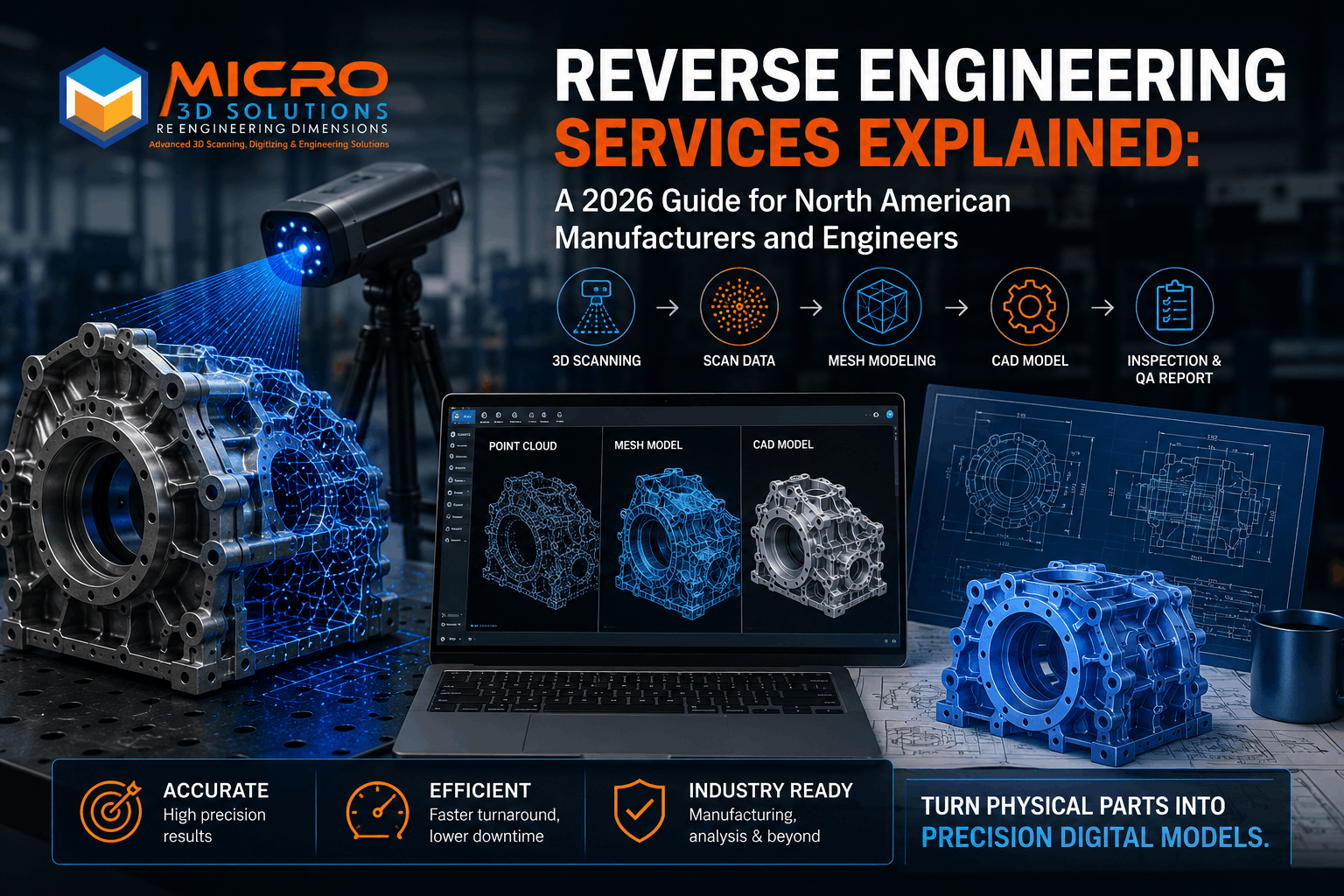
Modern reverse engineering follows a structured five-stage workflow. Each stage builds on the last — and each is a potential point where quality is either preserved or lost.
3D Scanning the Physical Part
The process begins by capturing the geometry of the object using 3D laser or structured-light scanners. Industrial scanners — blue-light, LiDAR, and laser tracking systems — capture shape, surface details, and exact dimensions to sub-millimetre precision. The output is a highly accurate digital representation of every external feature, including geometry too small or complex to measure by hand.
Converting Scan Data into Digital Geometry
Raw scanner output is a dense field of millions of measured points called a point cloud. Engineers process this through three intermediate forms: point cloud → polygon mesh → surface geometry. Each transformation cleans noise, fills gaps from occluded areas, and prepares the data for CAD reconstruction. This is the stage where engineering judgment matters most — a sloppy mesh produces a sloppy model regardless of how good the original scan was.
Creating the Parametric CAD Model
Using CAD reverse engineering software like SolidWorks, CATIA, Inventor, or Geomagic Design X, engineers rebuild the scanned geometry as a parametric, feature-based CAD model. Unlike a raw mesh, a parametric model can be modified — dimensions changed, features edited, the part redesigned for improvement, inspection, or manufacturing. This is the step that transforms a scan from a digital record into a working engineering asset.
Validation Against the Original Part
The newly constructed CAD model is compared against the original scan data using deviation analysis. Coloured heat maps show where the model matches the physical part within tolerance and where deviations exist. Critical features are checked against the original measurements. For aerospace and medical applications, this quality inspection step is non-negotiable — and it's where lower-quality reverse engineering services often cut corners.
Delivery as a Production-Ready Digital Asset
The validated CAD model becomes a versatile digital asset. It can be sent to a CNC machine for manufacturing, fed into 3D printing for rapid prototyping, used to produce 2D engineering drawings for fabrication, archived for regulatory documentation, or modified for next-generation redesign. Standard output formats include STEP, IGES, native SolidWorks, STL, and 2D PDF drawings.
Scanning technologies used in reverse engineering
The scanner selected at step one has an outsized impact on what is and isn't achievable. There is no single "best" scanner — different applications demand different tools, and matching the technology to the requirement is one of the most important decisions in any reverse engineering project.
| Technology | Best For | Typical Accuracy |
|---|---|---|
| Blue Light Scanning | High-precision small to mid-size parts; tooling, automotive, medical | ± 0.02–0.05 mm |
| Laser Scanning | Larger parts, free-form surfaces, rapid mid-accuracy capture | ± 0.05–0.1 mm |
| LiDAR Scanning | Buildings, large infrastructure, AEC and BIM applications | ± 1–6 mm |
| Laser Tracking | Very large assemblies, aerospace tooling, factory layouts | ± 0.015–0.05 mm over 30m+ |
| Industrial CT Scanning | Internal geometries impossible to measure without destruction | ± 0.01–0.05 mm (internal) |
| Underwater Scanning | Submerged components, marine, dam and pipeline inspection | ± 1–3 mm typical |
A professional provider will recommend the right combination of technologies for your project — sometimes using multiple methods on the same part. A large aerospace structure, for example, might require laser tracking for the overall envelope and blue light scanning for critical small features.
Industries that depend on reverse engineering
Reverse engineering isn't a marginal activity. In several of the largest industrial sectors across North America, it's now embedded in routine operations.
✈️ Aerospace & Defense
Legacy MRO on aging platforms. When original manufacturers exit the market, reverse engineering keeps fleets operational. Concentrated in Brampton, Mississauga, Montreal, and US aerospace hubs.
🚗 Automotive & EV
Tooling replication, classic vehicle restoration, aftermarket component development, and EV platform engineering. Driven by Ontario's automotive belt and US manufacturing centres.
🛢️ Oil, Gas & Energy
Replacement parts for remote installations where international shipping is prohibitive. Critical for Alberta's oil sands, Atlantic offshore platforms, and US shale operations.
🏛️ Heritage & Restoration
Historic buildings, monuments, museum artifacts, and architectural ornaments. Used to document and replicate items too fragile or rare to recreate manually.
🏥 Medical Devices
Patient-specific implants, prosthetics, and dental applications. Reverse engineering of anatomical scans enables custom-fit devices that traditional manufacturing cannot deliver.
🏗️ AEC & Construction
As-built BIM models for renovation, retrofit, and facility management. LiDAR scanning of existing structures produces accurate Revit models for commercial projects.
⚙️ Industrial & Tooling
Custom jigs, fixtures, conformal cooling inserts, and replacement parts for legacy machinery — the most common application category across North American manufacturing.
🌊 Marine & Underwater
Ship hull inspection, propeller analysis, submerged pipeline measurement, and dam infrastructure assessment using specialized underwater 3D scanning systems.
How much do reverse engineering services cost?
Reverse engineering pricing depends on five primary factors: part size, geometric complexity, required scanning technology, depth of CAD modeling, and whether on-site scanning is required. Here are typical North American price tiers in 2026:
One mechanical part with standard geometry. Blue-light or laser scan, parametric CAD model in STEP format.
Multi-part assemblies, precision tolerances, or specialized scanning. Full CAD reconstruction with inspection report.
Large structures, on-site scanning, aerospace or medical-grade work with full documentation and traceability.
Internal features requiring CT scanning, very tight tolerances (sub-25 micron), reflective or transparent materials needing surface preparation, on-site scanning logistics, rush turnaround, and additional deliverables like inspection reports or 2D manufacturing drawings.
Software and file formats
Professional reverse engineering providers work in industry-standard CAD packages. The right software depends on the deliverable format your downstream workflow needs. Common platforms include SolidWorks (most common for mechanical parts), CATIA (aerospace and automotive), Autodesk Inventor (industrial design), PTC Creo (advanced parametric work), Rhino (free-form surfaces), and Geomagic Design X (purpose-built for reverse engineering workflows).
For BIM-related reverse engineering of buildings and infrastructure, Autodesk Revit is the dominant platform. Standard output formats include STEP (.step / .stp) for cross-platform CAD interoperability, IGES (.igs) for legacy systems, native SolidWorks (.sldprt), STL for 3D printing, OBJ for visualization, and 2D PDF or DWG manufacturing drawings.
How to choose a reverse engineering provider
Not all reverse engineering providers deliver the same quality. The difference between a scan-and-model shop and a true engineering services provider becomes apparent on the first complex project. Here's what to evaluate:
- Scanning equipment range. Can they match the right technology to your part? A provider with only one type of scanner will push every project through that technology — regardless of whether it's optimal.
- Engineering expertise, not just scanning. The scan is only step one. Look for providers whose engineers understand manufacturing tolerances, GD&T, and the downstream workflow your model needs to feed.
- Validation as standard practice. Deviation analysis comparing the CAD model against the original part should be included — not an upcharge. Ask to see a sample inspection report.
- Software flexibility. Can they deliver in whatever native CAD format you need? A provider locked into one platform will produce conversion-degraded output.
- NDA and IP protection. Your parts often represent proprietary engineering. Confirm the provider operates under NDA and has clear data handling policies.
- Industry experience. Aerospace-grade work demands different rigor than industrial tooling. Choose a provider with proven experience in your specific industry.
Common pitfalls and how to avoid them
Reverse engineering projects fail in predictable ways. The most common mistakes — and how to avoid them:
- Scanning a worn or damaged part literally. A worn part will produce a CAD model of the worn version. Experienced engineers reconstruct the original design intent rather than reproducing the damage. This judgment matters more than equipment quality.
- Mismatching scanner accuracy to application. Using a LiDAR system for a precision automotive part will produce a model accurate to several millimetres — far outside acceptable tolerance. Technology selection must match the application.
- Skipping surface treatment on reflective parts. Polished metals and clear plastics scatter scanner light. Surface treatment with matte spray (vanishing aerosol) is standard practice for high-precision work.
- Receiving a mesh when you need parametric. A raw mesh can't be modified, dimensioned, or used for manufacturing efficiently. Always specify whether you need a parametric, feature-based CAD model rather than just a 3D surface.
- No validation step. Without deviation analysis comparing the CAD model to the original part, you have no objective measure of accuracy. Insist on validation as part of the deliverable.
North American market trends in 2026
Three trends are reshaping reverse engineering services across Canada and the United States this year.
AI-assisted mesh cleanup and CAD reconstruction is becoming standard practice. AI tools now automate noise reduction, feature recognition, and basic CAD reconstruction from scan data — reducing engineering time by 30–50% for routine projects and freeing senior engineers to focus on judgment-intensive work.
Cloud-based collaboration is enabling distributed engineering teams to work simultaneously on the same reverse engineering project. A scan captured on-site in Alberta can be modeled in Ontario, reviewed by stakeholders in Texas, and delivered to a manufacturing partner in Quebec — all within a single shared CAD environment.
Integrated scan-to-print workflows are collapsing the time from "physical part" to "new manufactured part." Providers like Micro 3D Solutions offer end-to-end pipelines combining 3D scanning, CAD modeling, and additive manufacturing under one roof — eliminating handoffs and compressing project timelines significantly.
Industry analysis projects continued North American dominance of the reverse engineering market through 2030 — driven by aerospace MRO demand, automotive supply chain restructuring, infrastructure renewal, and the broader push toward reshored manufacturing capability across Canada and the United States.
Frequently asked questions
Reverse engineering services start with a physical object and work backwards to figure out how it was designed and built. Engineers capture the object with a 3D scanner and rebuild it as a precise digital CAD model that can be used to manufacture, analyze, or improve the part — even when the original drawings no longer exist.
A typical reverse engineering project takes 3–10 business days depending on part complexity. Simple geometry parts can be completed in 2–3 days. Complex assemblies with internal features, multiple components, or aerospace-grade tolerances may take 1–3 weeks. On-site scanning at the client location adds logistics time but is essential for large or non-transportable parts.
Yes — reverse engineering is legal for most industrial applications including replacing obsolete parts on equipment you own, restoring legacy components, creating spare parts for aging infrastructure, and quality inspection. It becomes legally complicated when used to replicate patented designs, trademarked products, or copyrighted software still under active IP protection without authorization. Reputable providers like Micro 3D Solutions operate under NDA and only work on parts where the client has legitimate ownership or rights.
Standard output formats include STEP (.step / .stp) for interoperability, IGES (.igs) for legacy CAD systems, native SolidWorks (.sldprt), CATIA (.CATPart), Inventor (.ipt), STL for 3D printing, OBJ for visualization, and 2D PDF or DWG manufacturing drawings. The provider should deliver in whichever format your downstream manufacturing or analysis workflow requires.
Accuracy depends entirely on the scanning technology used. Blue-light scanners deliver ± 0.02–0.05 mm for precision parts. Laser scanners deliver ± 0.05–0.1 mm. Industrial CT scanning achieves ± 0.01 mm and can measure internal features. LiDAR scanning is much coarser at ± 1–6 mm but is appropriate for buildings and large structures. The right technology produces a CAD model accurate enough to manufacture from directly.
Yes, but only with the right technology. External scanners (blue-light, laser, structured-light) capture only what they can see from outside. For internal channels, wall thicknesses, voids, or sealed cavities, industrial CT scanning is required. CT scans pass X-rays through the part to produce a complete 3D map of internal and external features simultaneously — without destructive sectioning.
Regular 3D modeling services start from sketches, specifications, or design intent — building a model forward from an idea. Reverse engineering starts from a physical object that already exists and works backwards, capturing its real-world geometry and reconstructing it digitally. Both produce CAD models, but the input, methodology, and quality control steps are fundamentally different.
Need a Part Reverse Engineered?
Micro 3D Solutions delivers full-service reverse engineering across North America — blue-light scanning, LiDAR, laser tracking, underwater scanning, and parametric CAD reconstruction from our Richmond Hill, Ontario facility.
Contact Our Engineering Team →Learn more about our complete service range: 3D Modeling Services Guide, 3D Laser Scanning, 3D CAD Modeling, Quality Inspection, 3D Printing, and 2D to 3D Conversion. Visit our About Us page to learn about our team, or contact us for a project quote.