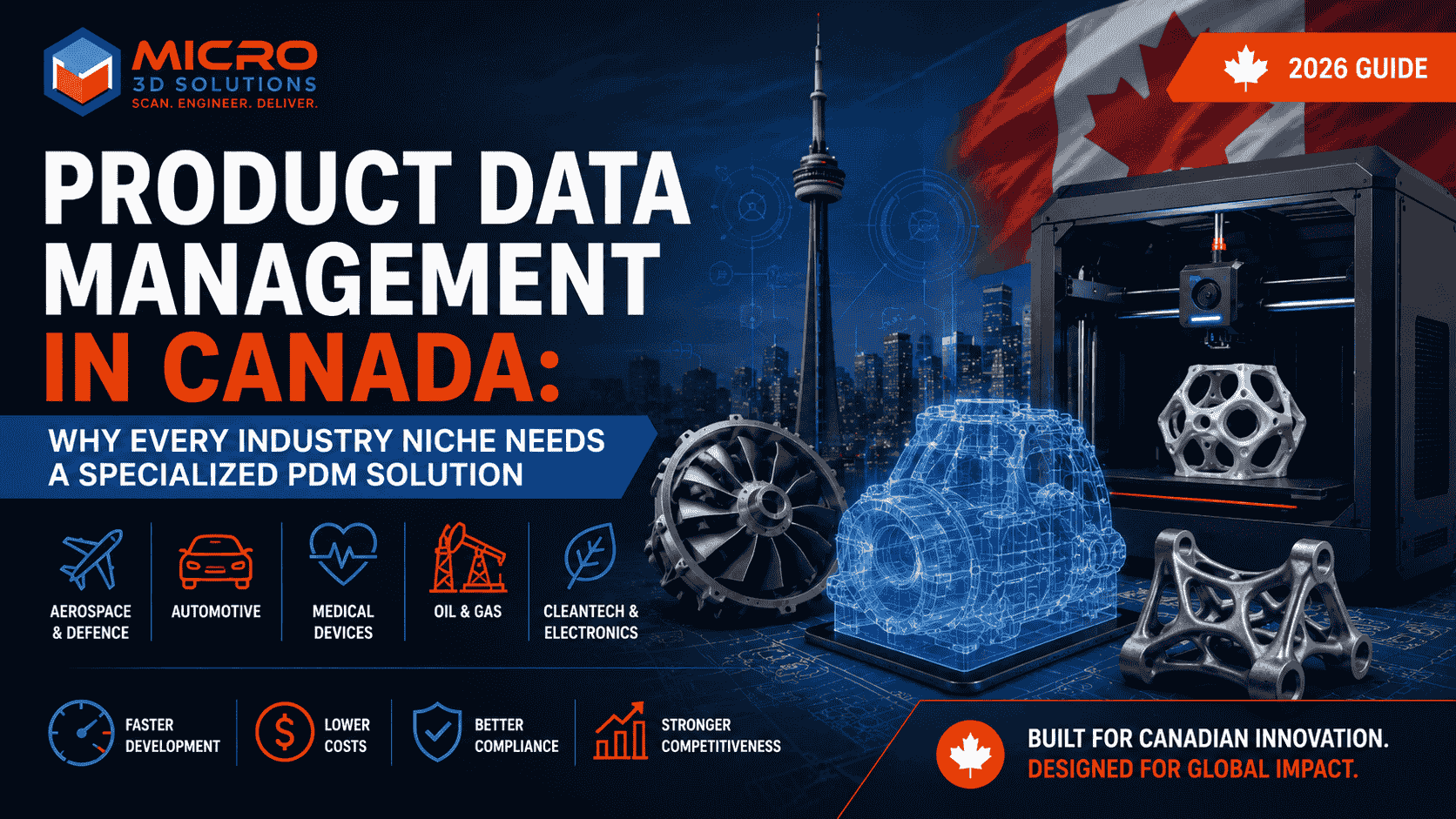
Product Data Management in Canada: Why Every Industry Niche Needs a Specialized PDM Solution
Every year, Canadian manufacturers lose millions to version-control errors, outdated CAD files, and disconnected engineering data. PDM solves this — but not all PDM is built for the same industry.
What Is Product Data Management?
What is Product Data Management (PDM)?
Product Data Management (PDM) is a centralized software system that stores, organizes, and controls all product-related data across a product's lifecycle — CAD files, engineering drawings, Bills of Materials (BOMs), specifications, and revision histories. Its purpose: ensure every team member always works from the same current, approved version of product data.
The core purpose is simple: ensure every person on your team — from design engineers to manufacturers to compliance officers — is always working from the same, most current, approved version of product data. This is the foundation of effective engineering document management and reliable CAD data management.
But here is what most generic explanations miss: not all PDM is created equal. An aerospace firm in Montréal managing titanium component designs has completely different requirements than a medical device startup in Waterloo or an oil sands operator in Fort McMurray.
This guide explores why industry-specific PDM matters, how Canada's key sectors are using it in 2026, and what to look for when choosing the right solution for your niche.
The State of Product Data Management in Canada Right Now
Canada's manufacturing and engineering sectors are accelerating their adoption of PDM solutions — and the numbers back it up.
The global PDM software market was valued at USD $3.26 billion in 2025 and is projected to reach USD $6.12 billion by 2033, growing at a CAGR of 8.19% — driven by cloud-based adoption, enhanced enterprise integration, and rising demand for centralized product data solutions across manufacturing, automotive, aerospace, and high-tech industries globally (Global Growth Insights, PDM Software Market Report, 2025).
Adoption rates exceed 64% across manufacturing sectors, with 58% of companies reporting faster product development cycles and 52% noting improved team coordination. Over 56% of enterprises use PDM for design collaboration, while 49% integrate it with ERP and PLM systems to boost efficiency (Global Growth Insights, 2025). Canada's manufacturing sector — particularly aerospace and automotive — contributes significantly to regional growth, with government Industry 4.0 initiatives adding momentum (Deloitte 2026 Manufacturing Industry Outlook).
Why it matters: For Canadian businesses, this is not just a technology trend — it is a competitive reality. Companies that manage their product data well move faster, make fewer errors, and stay compliant in an increasingly regulated landscape.
How Product Data Flows: CAD → PDM → ERP
Understanding where PDM sits in the digital manufacturing stack is the key to understanding its value. PDM is the controlled bridge between engineering design and business operations — the single source of truth that keeps manufacturing data management accurate from the first sketch to the production floor.
CAD
Engineers create 3D models, drawings & BOMs in SOLIDWORKS, Creo, NX, CATIA
PDM
Centralizes, version-controls & approves all design data with full audit trail
ERP
Approved BOMs flow to procurement, production planning & inventory (SAP, Oracle)
Without PDM in the middle, engineering data reaches ERP and the shop floor through manual handoffs — the exact point where version-control errors, outdated revisions, and costly rework creep in. PDM closes that gap and forms the backbone of a connected digital thread in manufacturing.
Why Generic PDM Is No Longer Enough
A standard, off-the-shelf PDM system can manage files and track versions. But Canada's most competitive industries face challenges that go far beyond basic file management:
- Strict regulatory compliance (Health Canada, Transport Canada, AS9100, ISO 13485)
- Multi-site, cross-border collaboration with US partners and global supply chains
- Complex product configurations with thousands of components and variants
- Integration with specialized CAD platforms (CATIA, SOLIDWORKS, NX, Creo)
- Audit trail requirements that can span decades
While manufacturing, automotive, and aerospace are traditional PDM users, its use now extends into consumer electronics, medical devices, and software development. The system's ability to handle complex data relationships makes it valuable in any sector where product development involves multiple stakeholders and stringent regulatory requirements.
This is why industry-specific PDM has emerged as the gold standard. Let's look at how Canada's major industry niches are applying it.
Aerospace & Defence: PDM Under the Highest Pressure
Canada's aerospace cluster — anchored by Bombardier, CAE, Pratt & Whitney Canada, and hundreds of Tier-1 and Tier-2 suppliers — is one of the most demanding environments for product data management in the world.
Aerospace & Defence
Unique Challenges
- Revision histories spanning 20–40 years
- Millions of part numbers per aircraft program
- Airtight configuration management — one wrong revision can ground a fleet
- AS9100 & ITAR audit trails for every change event
PDM Must Deliver
- Full configuration management & change control
- Integrated electronic work orders & ECNs
- Digital twin readiness — design to as-built records
- Compliance documentation built into the workflow
Enterprise-grade platforms like PTC Windchill and Siemens Teamcenter dominate this space. Windchill offers unmatched process depth and native Creo integration, while Teamcenter — widely adopted by organizations like Boeing — delivers manufacturing process management and digital twin capabilities beyond standard PDM.
Consider a typical Montréal Tier-1 aerospace supplier still managing engineering change orders through shared network drives and email approvals. After consolidating onto a centralized PDM environment with formal change-control workflows, suppliers in this position commonly report 25–35% reductions in engineering change processing time and a sharp drop in revision errors reaching the shop floor — a critical advantage when bidding on prime-contractor work.
For Canadian aerospace suppliers looking to win contracts with Bombardier or prime defence contractors, a certified, auditable PDM system is increasingly a prerequisite — not a differentiator. The accuracy of the underlying CAD models and engineering drawings feeding that system is what makes the audit trail meaningful.
Automotive: Speed, Variants, and Supply Chain Complexity
Southern Ontario remains Canada's automotive heartland. With major assembly plants, hundreds of Tier-1 and Tier-2 suppliers, and a growing EV supply chain emerging across Ontario and Québec, the automotive sector faces a specific set of PDM demands.
Automotive
Unique Challenges
- Thousands of variants across multiple model years
- Design data across global teams (Detroit, Stuttgart, Tokyo)
- Supplier BOM sharing without losing version control
- IATF 16949 quality compliance
PDM Must Deliver
- Multi-CAD support (CATIA, NX, SOLIDWORKS)
- BOM management with variant & option handling
- Supplier portal with controlled data sharing
- ERP integration (SAP, Oracle) for design-to-procurement
Integration with CAD systems, ERP platforms, and Manufacturing Execution Systems (MES) has become a critical differentiator in automotive PDM — and nowhere more so than in Canada, where design, production planning, and procurement must all operate from a single synchronized source of product data.
Canada's EV transition adds another layer. Battery system designs, power electronics, and new material specifications demand PDM that handles rapid iteration cycles while maintaining full traceability and tight engineering change management across the supply chain. Clean, parametric CAD models and 2D manufacturing drawings are the raw material every automotive PDM system depends on.
Medical Devices & Life Sciences: Compliance Is Not Optional
Canada's medical device sector — with hubs in Toronto, Waterloo, Vancouver, and Montréal — operates under some of the strictest regulatory frameworks of any industry. Health Canada's Medical Devices Regulations, combined with ISO 13485 and FDA 21 CFR Part 820 (for the US market), create a documentation burden generic PDM simply cannot handle.
Medical Devices & Life Sciences
Unique Challenges
- Design History Files (DHF) maintained for device lifetime
- Every change requires documented risk assessment
- Traceability from raw material to finished product
- Software-as-a-Medical-Device (SaMD) classification
PDM Must Deliver
- ISO 13485 document control with e-signatures
- Integrated CAPA management
- DHF/DMR management built in
- Full audit trail with timestamps & justifications
For industries where traceability and precision are paramount, Model-Based Definition (MBD) standards provide the foundation for reliable digital collaboration. MBD strengthens compliance readiness by automatically tracking every revision and specification within the design environment — particularly valuable for Canadian medical device companies managing complex regulatory submissions. Accurate parametric CAD modeling and MBD-ready 3D models are what make this level of traceability possible.
A Waterloo-based medical device startup preparing its first Health Canada submission can spend weeks manually assembling a Design History File from scattered drawings, emails, and spreadsheets. With an ISO 13485-aligned PDM in place from day one, that same DHF is generated continuously as a byproduct of the design process — turning a multi-week documentation scramble into a near-instant, audit-ready export.
For Canadian medical device companies seeking Health Canada licensing or US FDA clearance, a compliant PDM system is not a productivity tool — it is the backbone of the entire regulatory strategy.
Oil & Gas: Managing Product Data Across Harsh Environments
Alberta's oil sands, offshore Atlantic operations, and the broader Western Canadian energy sector present a unique PDM challenge: managing the product and engineering data for massive, long-life capital assets operating in extreme conditions.
Oil & Gas
Unique Challenges
- Equipment operating 30–50 years needs decades of revision management
- Alberta Energy Regulator (AER) compliance complexity
- Remote sites need robust access controls & offline capability
- Environmental compliance integrated with engineering data
PDM Must Deliver
- Integration with plant design & asset management
- Long-term archiving with guaranteed retrieval
- Regulatory change tracking tied to specifications
- Multi-site access for field, offshore & head office
The regulatory environment for Canadian oil and gas has never been static — and the pace of change in 2025 and 2026 has accelerated sharply. The AER overhauled its entire liability management framework in early 2025, releasing new editions of Directives 001, 011, 068, and 088 and replacing the legacy Licensee Liability Rating (LLR) program (Alberta Energy Regulator, Bulletin 2025-04). For operators, product and equipment documentation systems must be flexible enough to adapt to ongoing regulatory change without losing historical traceability.
As Canada's energy sector navigates environmental transition and tightening AER regulations, the ability to maintain clean, auditable product and asset data is becoming a direct operational risk management issue — not just an engineering convenience. Where original drawings are missing for legacy equipment, reverse engineering and scan-to-CAD services rebuild the accurate digital records a PDM system depends on.
Consumer Electronics & Clean Technology: Speed to Market Is Everything
Canada's growing clean technology and consumer electronics sectors — from smart grid hardware companies in Ontario to EV charging infrastructure manufacturers in BC — face a completely different set of PDM priorities: speed, iteration, and global supply chain coordination.
Cleantech & Consumer Electronics
Unique Challenges
- Development cycles measured in months, not years
- Hardware & firmware revisions managed in sync
- Global contract manufacturing needs precise BOM sharing
- Rapid change orders from component shortages
PDM Must Deliver
- Agile change management with fast approvals
- Hardware-software co-design data management
- Supplier & contract manufacturer portals
- Cloud-native architecture without VPN complexity
Product cycles in industrial equipment and electronics have compressed dramatically. Competitive pressure and faster development timelines have shortened the gap between product creation and first sale — which means the product data process must keep pace. For Canadian cleantech companies racing to market, a slow or disorganized PDM workflow built on outdated cloud PDM software is a direct competitive disadvantage.
Industry Compliance Matrix: What Each Sector Must Track
Different Canadian industries answer to different regulators and standards. This matrix maps the core compliance requirements your PDM system must support by sector.
| Requirement | Aerospace | Automotive | Medical | Oil & Gas | Cleantech |
|---|---|---|---|---|---|
| Configuration Management | ✓ | ✓ | ✓ | ✓ | ○ |
| Industry Standard | AS9100 | IATF 16949 | ISO 13485 | AER Directives | ISO 9001 |
| Audit Trail Retention | 20–40 yrs | 15 yrs | Device lifetime | 30–50 yrs | 5–10 yrs |
| Electronic Signatures | ✓ | ○ | ✓ | ✓ | ○ |
| Multi-CAD Support | ✓ | ✓ | ○ | ✓ | ○ |
| Offline / Remote Access | ○ | ○ | ○ | ✓ | ✓ |
| Rapid Change Cycles | ○ | ✓ | ○ | ○ | ✓ |
| Data Residency (PIPEDA) | ✓ | ✓ | ✓ | ✓ | ✓ |
✓ = critical requirement · ○ = situational. Based on Canadian regulatory frameworks, 2026.
PDM vs PLM vs ERP: What's the Difference?
How do PDM, PLM, and ERP differ?
PDM manages engineering design data (CAD, BOMs, drawings) within the engineering team. PLM manages the entire product lifecycle — concept to retirement — across the whole organization. ERP manages business operations like procurement, inventory, and finance. PDM is the data foundation that feeds accurate information into both PLM and ERP.
This is one of the most common questions Canadian buyers ask — and confusing the three leads to buying the wrong system. Here's a clear breakdown of product lifecycle data management layers:
| Dimension | PDM | PLM | ERP |
|---|---|---|---|
| Primary Focus | Engineering design data | Full product lifecycle | Business operations |
| Manages | CAD, BOMs, drawings, revisions | Design + process + service + sunset | Procurement, inventory, finance, HR |
| Primary Users | Engineers & designers | Cross-functional teams | Operations, finance, procurement |
| Scope | Narrow & deep | Broad & strategic | Enterprise-wide |
| Relationship | Core component of PLM | Contains PDM | Consumes PDM/PLM data |
| Example Tools | SOLIDWORKS PDM, Vault | Windchill, Teamcenter, Aras | SAP, Oracle, Dynamics |
In short: PDM is commonly described as the core data layer within a larger PLM strategy, while ERP consumes that approved data to run the business. Most Canadian SMBs start with PDM, then expand into PLM as their processes mature.
Need Help Selecting the Right PDM Solution?
The quality of your PDM system depends on the quality of the CAD data, BOMs, and engineering drawings inside it. Our engineering team can help you build clean, accurate, audit-ready product data — tailored to your industry's Canadian compliance requirements.
Request a Free Assessment →🇨🇦 Ontario-based team · CAD & BOM data · Scan-to-CAD & 3D inspection
Choosing the Right PDM Solution for Your Industry Niche
With so many specialized requirements, how do Canadian companies choose the right PDM platform? Here is a practical framework matching industry to PDM tier and must-have features.
| Industry | Recommended PDM Tier | Key Must-Have Features |
|---|---|---|
| Aerospace & Defence | Enterprise (Windchill, Teamcenter) | Configuration management, AS9100, digital twin |
| Automotive | Enterprise / Mid-market (Teamcenter, Enovia) | Multi-CAD, BOM variants, ERP integration |
| Medical Devices | Regulated (Arena, Veeva Vault) | ISO 13485, DHF/DMR, e-signatures |
| Oil & Gas | Asset-centric (OpenText, Meridian) | Long-term archiving, AER compliance, offline access |
| Cleantech / Electronics | Cloud-native (Arena, Propel) | Agile workflows, HW-SW sync, supplier portals |
A notable 2026 market development is the growing number of mid-market PDM and PLM vendors — including Aras, Arena, and Propel — filling the gap between heavyweight enterprise platforms and basic file management. This is especially relevant for Canadian SMBs in regulated industries that need compliance-grade PDM without six-figure implementation costs.
Four Questions Every Canadian Company Should Ask
- Does it natively integrate with the CAD tools your engineers already use?
- Does it support the specific regulatory compliance framework your industry requires?
- Can it scale — from 10 users today to 200 users in five years?
- What is the real total cost of ownership, including implementation, training, and support?
Before you evaluate any PDM platform: the system is only as good as the data inside it. Inconsistent CAD models, missing drawings, and inaccurate BOMs undermine even the best PDM. If your engineering data needs cleanup, standardization, or reverse engineering from legacy parts, our team can prepare PDM-ready CAD and BOM data before you migrate — saving weeks of rework during implementation.
The Future of PDM in Canada: What's Coming Next
AI-Powered Data Intelligence
Artificial intelligence is transforming PDM from a passive repository into an active intelligence layer. AI tools now flag revision conflicts before they happen, suggest related design files, and auto-classify documents based on content — dramatically reducing the manual overhead of keeping product data clean and organized.
Cloud PDM Adoption Accelerating
Over 45% of PDM implementations now rely on cloud-based solutions. For Canadian companies with distributed teams — design in Toronto, manufacturing in Windsor, a supplier in Mexico — cloud PDM eliminates VPN bottlenecks and IT overhead while improving real-time collaboration. This makes enterprise-grade Industry 4.0 data management accessible to mid-sized manufacturers.
Digital Thread & Digital Twin Integration
Canada's most advanced manufacturers are connecting PDM with real-world operational data, creating a "digital thread" that links design intent to manufactured product to in-service asset. This is transforming PDM from an engineering tool into a business intelligence platform — one of the most significant shifts in Canadian manufacturing over the next five years.
Design
CAD intent & specifications
PDM Core
Single source of truth
Manufacture
As-built records
In-Service
As-maintained asset data
Where the digital thread breaks most often is at the very start — when the design data entering PDM is incomplete or inaccurate. This is why precise scan-to-CAD and 3D inspection are increasingly treated as the foundation of the entire data lifecycle, not an afterthought.
Frequently Asked Questions About Product Data Management
What is Product Data Management (PDM)?
PDM is a software system that centralizes the storage, version control, and management of all product-related data — CAD files, engineering drawings, Bills of Materials, and specifications. It ensures all team members work from the same current, approved version, reducing errors and accelerating development cycles.
Why do different industries need specialized PDM solutions?
Different industries face unique regulatory requirements, design complexities, and workflow demands a generic PDM cannot address. Aerospace requires configuration management and AS9100. Medical devices need ISO 13485 document control. Oil and gas needs decades-long archiving and AER compliance. A one-size-fits-all approach leaves critical gaps that create compliance risk and inefficiency.
What is the difference between PDM and PLM?
PDM focuses specifically on engineering files, CAD data, BOMs, and design documents — typically within the engineering team. PLM (Product Lifecycle Management) is broader, covering the entire lifecycle from concept to retirement, including manufacturing, sales, and service. PDM is commonly described as a core component within a larger PLM strategy, handling the data management layer specifically.
What is the cost of PDM implementation in Canada?
Costs vary widely. Entry-level CAD-integrated PDM (SOLIDWORKS PDM, Autodesk Vault) starts around $1,500–$3,000 CAD per seat. Mid-market cloud platforms run $50–$150 CAD per user monthly. Enterprise systems like Windchill or Teamcenter involve six-figure implementations including configuration, integration, and training. Always evaluate total cost of ownership — implementation, data migration, and ongoing support.
How long does PDM deployment take?
A basic CAD-integrated PDM vault can be operational in 2–6 weeks. Mid-market cloud PDM typically takes 1–3 months including data migration and workflow configuration. Enterprise deployments in regulated industries can take 6–18 months due to validation, compliance documentation, and integration with ERP and CAD systems.
Can small manufacturers benefit from PDM?
Yes. Small and mid-sized Canadian manufacturers benefit significantly through reduced version-control errors, faster engineering change management, and improved BOM accuracy. Cloud-native mid-market platforms (Arena, Propel, Autodesk Vault) now make compliance-grade PDM accessible without six-figure enterprise costs.
Which CAD systems integrate best with PDM?
Most major PDM platforms offer native CAD integration: SOLIDWORKS PDM with SOLIDWORKS, PTC Windchill with Creo, Siemens Teamcenter with NX, and Autodesk Vault with Inventor and Fusion 360. Multi-CAD environments — common in automotive and aerospace — need platforms like Teamcenter or Aras that support CATIA, NX, SOLIDWORKS, and Creo simultaneously.
Is cloud-based PDM secure enough for regulated Canadian industries?
Yes — modern cloud PDM built for regulated industries offers enterprise-grade security: role-based access control, full audit trails, Canadian data-residency options, and encryption at rest and in transit. For industries subject to ITAR, PIPEDA, or provincial privacy law, verify your provider offers Canadian or compliant data hosting. Most enterprise vendors now support this.
How does PDM integrate with ERP systems in Canadian manufacturing?
Modern PDM integrates with ERP platforms like SAP, Oracle, and Microsoft Dynamics through standardized APIs and middleware connectors. Engineering BOMs created in PDM flow directly into manufacturing and procurement, eliminating manual re-entry, reducing errors, and keeping purchasing and production aligned with the latest approved design data — increasingly essential for Industry 4.0 readiness.
Final Thoughts
Product Data Management is not a luxury for large corporations. In 2026, it is the operational foundation that allows Canadian engineers, manufacturers, and product teams to move faster, stay compliant, and collaborate without losing control of their most critical asset: their product data.
But the key insight is this — generic PDM is not enough. The specific regulatory pressures, design complexities, and workflow demands of Canada's aerospace, automotive, medical device, oil and gas, and cleantech sectors require solutions built for those realities, not adapted from a generic template.
The question is no longer whether your organization needs a PDM system. It's whether the one you have — or the one you're evaluating — is truly built for the industry you operate in. And whether the CAD data and engineering drawings inside it are accurate enough to trust.
🔗 Related Reading
Rapid Prototyping in Canada (2026)
FDM vs SLA vs SLS, costs, materials & the complete prototyping workflow.
Services3D Modeling & CAD Services Explained
Scan-to-CAD, reverse engineering, 2D drawings & BOM creation.
Get StartedTalk to Our Engineering Team
Request a free assessment for your CAD data & PDM-ready deliverables.
📚 Sources & References
- Global Growth Insights — Product Data Management Software Market Report, 2025. globalgrowthinsights.com
- Deloitte — 2026 Manufacturing Industry Outlook. deloitte.com
- IntelMarketResearch — Product Data Management / Data Management Software Market. intelmarketresearch.com
- Alberta Energy Regulator — Bulletin 2025-04: New Editions of Directives 001, 011, 068 & 088 (Liability Management Framework). aer.ca
Published for Canadian readers in the Product Engineering & Manufacturing niche. Market statistics sourced from Global Growth Insights (2025), Deloitte 2026 Manufacturing Industry Outlook, and IntelMarketResearch; regulatory references from the Alberta Energy Regulator. Representative scenarios are illustrative, based on typical Canadian implementation patterns. Updated for 2026.