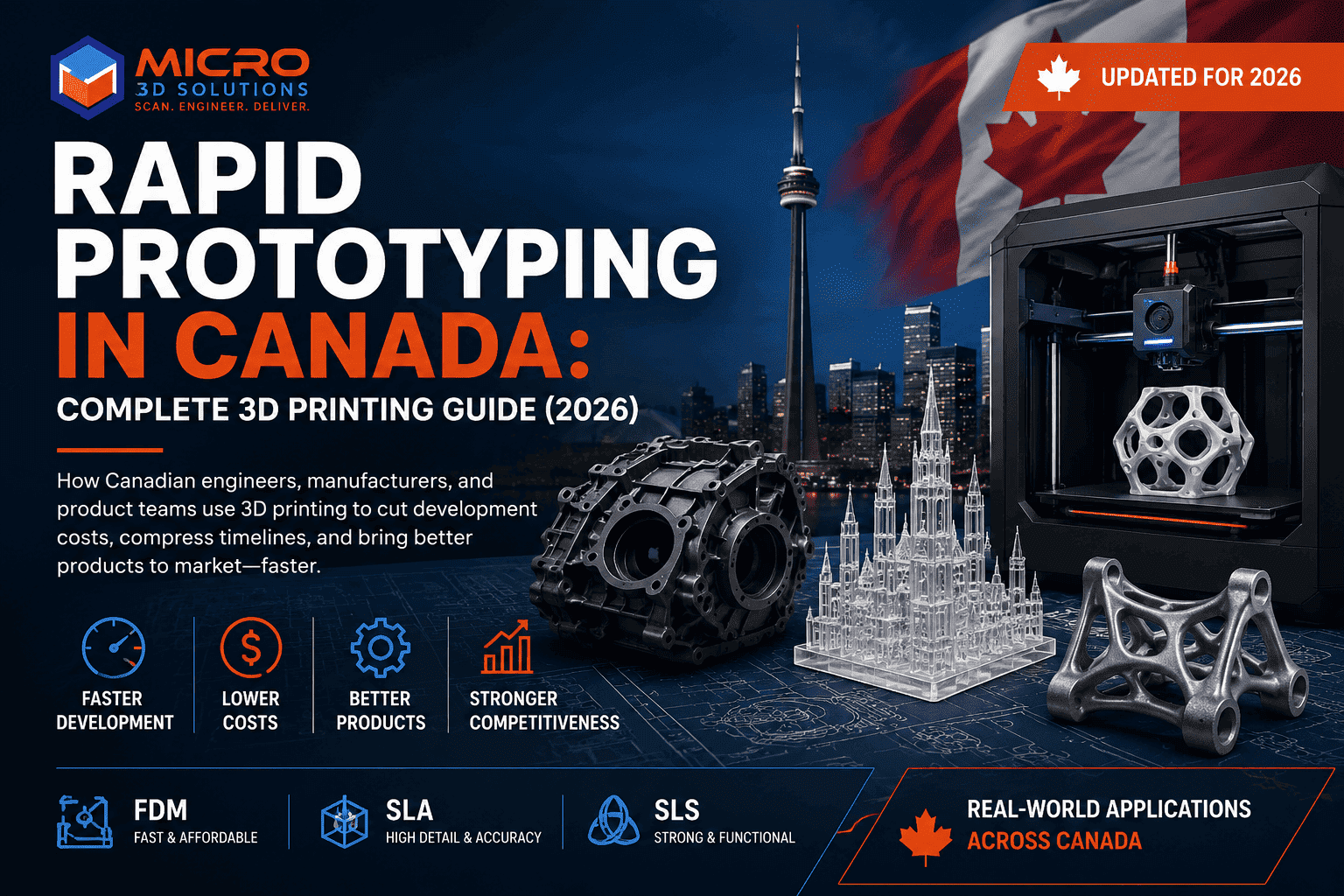
Rapid Prototyping in Canada:
Complete 3D Printing Guide (2026)
How Canadian engineers, manufacturers, and product teams use 3D printing to cut development costs, compress timelines, and bring better products to market — faster.
What Is Rapid Prototyping?
What is rapid prototyping?
Rapid prototyping is the fast creation of a physical model or functional prototype directly from a digital 3D design — primarily using additive manufacturing technologies like 3D printing. The process enables design teams to go from concept to physical object within hours, compressing development cycles that once took weeks or months.
The core workflow is elegantly simple: design → print → test → refine → repeat. This compressed cycle catches design errors early, validates ideas quickly, and communicates concepts clearly — before a single dollar is invested in production tooling.
According to ASTM F42 Committee on Additive Manufacturing Technologies, rapid prototyping encompasses any process that produces prototype parts directly from CAD data, with additive manufacturing being the dominant enabling technology. The standard (ASTM F2792) defines additive manufacturing as "a process of joining materials to make objects from 3D model data, usually layer upon layer" — a process that has fundamentally changed product development economics globally.
Industry Definition: The Wohlers Report 2025 defines rapid prototyping as the use of additive manufacturing to produce scale models or functional parts for design verification before committing to production tooling — typically reducing iteration cycles from 6–12 weeks to 24–72 hours.
Why Rapid Prototyping Matters in Canada Right Now
Canada is not watching from the sidelines. It is one of the earliest and most active implementers of 3D printing innovations across North America. From aerospace hubs in Montréal to automotive suppliers in Southern Ontario and medical device companies in Vancouver, Canadian industries are integrating rapid prototyping into their core product development workflows.
North America holds over 35% of global 3D printing revenue, with Canada ranked as a leading market alongside the United States. More than 68% of companies using 3D printing leverage it specifically for prototyping and pre-series manufacturing, according to the Sculpteo State of 3D Printing Report 2025.
For Canadian businesses — especially startups, engineering firms, and manufacturers — rapid prototyping is no longer a competitive advantage. It is becoming a baseline operational requirement across every major industry sector.
Canadian Market Context: Canada's manufacturing sector contributed over $178 billion to GDP in 2024 (Statistics Canada). Advanced manufacturing technologies, including additive manufacturing, are a cornerstone of Canada's Innovation and Skills Plan — with dedicated funding streams available through ISED (Innovation, Science and Economic Development Canada) and the NRC IRAP program.
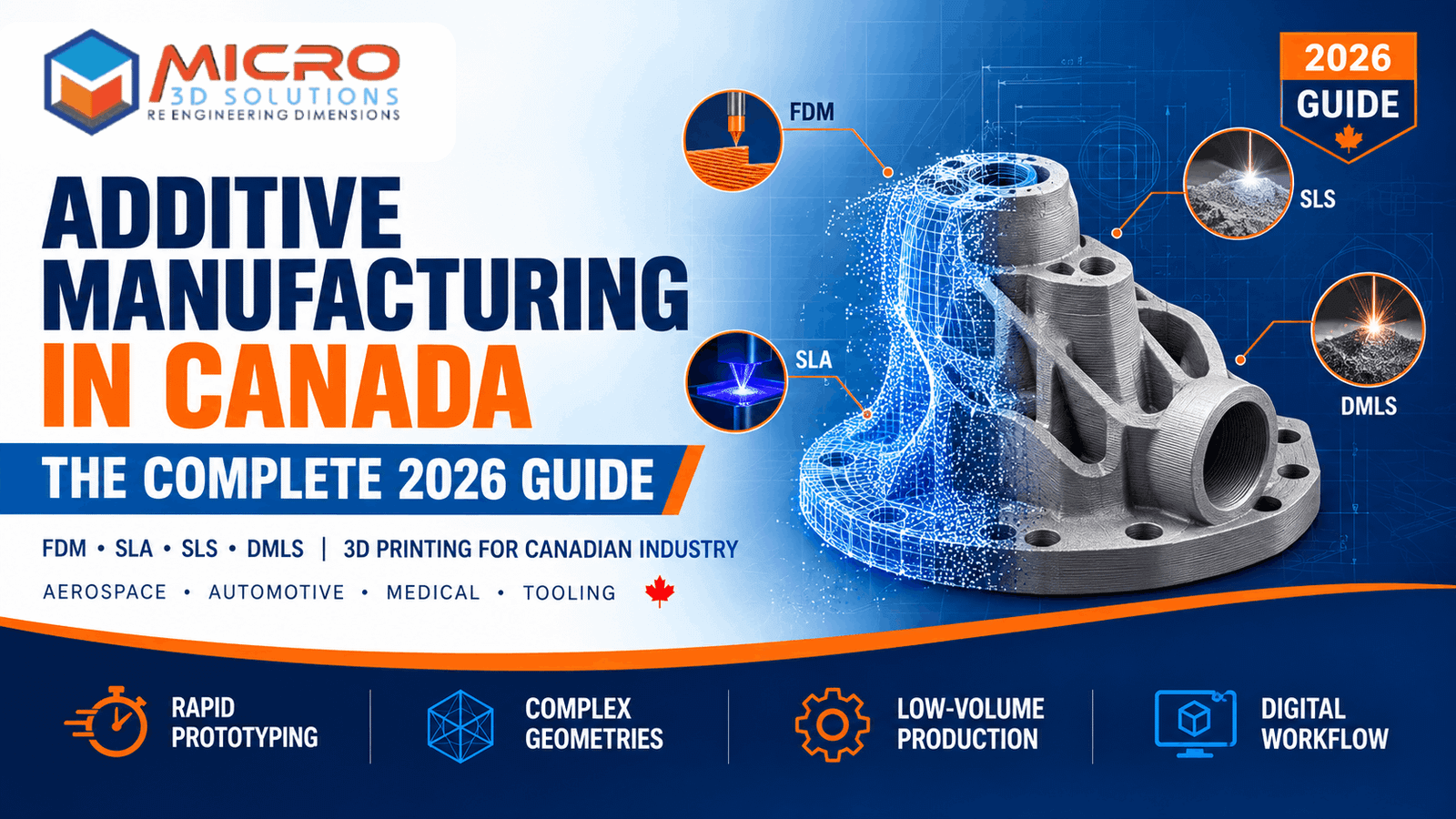
The Three Core 3D Printing Technologies for Rapid Prototyping
Not all rapid prototyping is the same. Choosing the right technology depends on your project phase, budget, material requirements, and the level of detail or mechanical performance you need. Here are the three dominant methods used by Canadian engineering teams.
Fused Deposition Modeling
Best for: Quick iterations, functional concept models, budget-conscious prototyping
FDM is the most widely recognized and accessible form of 3D printing. It works by melting thermoplastic filament (PLA, ABS, PETG, Nylon, Carbon-Fiber composites) and depositing it layer by layer to build a three-dimensional object.
Desktop FDM printers are available for under $500 CAD — making FDM viable for small businesses, engineering departments, and individual designers. Simple parts can be printed in under an hour. The Wohlers Report 2025 identifies FDM as the world's most widely installed additive manufacturing process, with over 2 million desktop units in North America alone.
ADVANTAGES
- Lowest cost per part
- Fastest turnaround for simple parts
- Wide material selection
- Accessible hardware
- Suitable for large parts
LIMITATIONS
- Visible layer lines
- Limited fine detail
- Anisotropic properties
- Post-processing needed for smooth finish
Pro Tip: For housing prototypes and mechanical assemblies, ABS or PETG is preferred over PLA for better impact resistance and thermal stability. Carbon-fibre reinforced nylon is ideal for high-stress functional testing.
Stereolithography
Best for: High-detail prototypes, client presentations, dental and medical models
SLA uses a UV laser to cure liquid resin layer by layer, producing parts with exceptional surface finish and resolution. SLA can achieve tolerances as fine as 0.01mm — making it the go-to choice when detail and appearance matter above all else.
According to the Wohlers Report 2025, SLA remains the preferred technology for medical device models, consumer electronics ergonomic testing, and architectural scale models in North American professional markets. Its isotropic material properties ensure consistent strength in all directions, unlike FDM.
ADVANTAGES
- Near injection-moulded surface quality
- Sub-0.05mm accuracy
- Isotropic material properties
- Ideal for micro-features
- Wide resin material range
LIMITATIONS
- Post-processing required (wash + cure)
- Resin handling safety requirements
- Higher material cost
- UV-sensitive; degrades outdoors
Selective Laser Sintering
Best for: Functional, production-ready parts, complex geometries, batch prototyping
SLS uses a high-powered laser to fuse powdered nylon (PA12) or other engineering polymers layer by layer. The unsintered powder acts as the support structure, eliminating the need for separate support removal — enabling the most geometrically complex parts of any 3D printing technology.
The Sculpteo Industrial AM Report 2025 identifies SLS as the fastest-growing prototyping technology in the aerospace, automotive, and oil & gas sectors in Canada, driven by demand for functional parts that withstand real-world stress conditions without secondary operations.
ADVANTAGES
- Excellent mechanical properties
- No support structures needed
- Complex geometries achievable
- Batch printing efficiency
- Production-grade durability
LIMITATIONS
- Higher per-part cost
- Grainy surface texture
- Requires professional-grade equipment
- Longer setup and cooling time
Industry Best Practice: Many professional prototyping teams in Canada use a hybrid approach — FDM for rapid early iterations, SLA for detailed validation models, and SLS for production-ready functional prototypes. This multi-technology workflow delivers the speed of FDM with the quality of SLA and the mechanical integrity of SLS at each project phase.
Advanced Technology Comparison: FDM vs SLA vs SLS
Which 3D printing technology is right for your project?
FDM is best for speed and budget; SLA delivers the highest surface quality and detail; SLS produces the strongest, most complex functional parts. Most Canadian engineering teams combine all three at different stages of the development cycle.
| Feature | FDM | SLA | SLS |
|---|---|---|---|
| Typical Canadian Cost | $10–$50 CAD/part | $50–$200 CAD/part | $100–$500+ CAD/part |
| Accuracy / Tolerance | ±0.2–0.5 mm | ±0.01–0.05 mm BEST | ±0.1–0.3 mm |
| Surface Finish | Visible layer lines; requires post-processing | Near injection-moulded BEST | Slightly grainy; sandable |
| Material Variety | Very wide — PLA, ABS, PETG, Nylon, CF composites | Wide — Standard, Tough, Flexible, Dental, Engineering resins | Moderate — PA12, PA11, Glass-filled, CF Nylon |
| Mechanical Strength | Moderate (anisotropic) | Moderate (isotropic) | Excellent (isotropic) BEST |
| Turnaround Time | Hours FASTEST | Hours–1 day (inc. post-processing) | 1–3 days (inc. cooling & cleanup) |
| Support Structures | Required (removable) | Required (light-touch) | Not required BEST |
| Complex Geometries | Limited by supports | Moderate | Excellent — undercuts, internal channels BEST |
| Functional Testing | Partial — fit & form only | Partial — appearance & ergonomics | Full functional testing capable BEST |
| Production Use | Low-volume jigs & fixtures | Dental, dental, medical models | End-use parts, batch production BEST |
| Best Applications | Concept models, housings, early iterations | Client models, dental, medical, micro-features | Aerospace, automotive, industrial, oil & gas |
| Equipment Accessibility | Desktop to industrial | Desktop to industrial | Industrial / service bureau only |
Sources: Wohlers Report 2025, Sculpteo State of 3D Printing Report 2025, Grand View Research 2025. Canadian cost estimates based on service bureau averages for Ontario, 2026.
The Complete Rapid Prototyping Process
Understanding the full prototyping workflow helps Canadian engineering teams plan projects accurately, allocate time and budget correctly, and avoid the costly mistakes that delay product launches. Here is the complete process from concept to production readiness.
Concept Development
Define the product's function, user requirements, and performance targets. Establish key design constraints — material requirements, load conditions, environmental exposure, regulatory standards (e.g., Health Canada for medical devices, Transport Canada for aerospace components). The clearer this stage, the fewer costly revisions downstream.
CAD Design
Convert your concept into a precise 3D digital model using professional CAD modeling software — SolidWorks, Fusion 360, Rhino, or CATIA. Model geometry must account for wall thicknesses, tolerances, and the specific constraints of the chosen printing technology. Undercuts and overhangs must be planned for FDM and SLA; SLS provides more geometric freedom.
Design for Additive Manufacturing (DfAM) Review
Before printing, a design review checks for printability: minimum feature sizes, wall thickness violations, unsupported spans, and geometry issues that could cause print failures. This stage is where experienced providers like Micro 3D Solutions add significant value — catching manufacturing problems that CAD software alone cannot flag.
Material Selection
Choose the material based on the prototype's purpose: appearance models use standard PLA or resin; functional prototypes require ABS, Nylon, or engineering-grade materials; production-intent parts use SLS nylon or carbon-fibre composites. See the Material Selection Guide below for a full breakdown.
Print Preparation (Slicing)
The CAD model (exported as .STL or .3MF) is processed in slicing software (Bambu Studio, PrusaSlicer, PreForm for SLA, or EOS Print for SLS). The slicer generates toolpaths, support structures, and layer parameters. Print orientation is critical — it affects surface quality, strength direction, support volume, and total print time.
Prototype Production
The printer builds the part layer by layer. FDM prints are completed in hours; SLA and SLS require additional post-processing — washing and UV curing for SLA, powder removal and bead blasting for SLS. Quality checks at this stage include dimensional verification and surface inspection against the original CAD model.
Testing and Validation
Prototype parts are tested against real-world performance criteria: fit and assembly verification, ergonomic testing, load testing, thermal resistance, or patient fit for medical devices. For advanced inspection, teams use 3D scanning and inspection services to compare as-printed geometry against the original CAD model with full deviation analysis.
Design Revision
Insights from testing feed back into the CAD model. Because 3D printing requires no tooling changes between iterations, design revisions can be implemented and re-printed the same day. The average rapid prototyping project requires 3–5 iteration cycles before a design is locked. Compare this to traditional machining, where each revision adds days and thousands of dollars.
Production Readiness & Documentation
Once the design is validated, 2D manufacturing drawings, Bills of Materials (BOMs), and production-ready CAD files are prepared for handoff to production suppliers. For regulated industries (aerospace, medical, automotive), this stage also includes compliance documentation and design freeze records required for regulatory approval.
Choosing the Right Material for Rapid Prototyping
Material selection is one of the most consequential decisions in the prototyping workflow. The wrong material choice leads to failed tests, misleading results, and wasted iteration cycles. Here is a complete guide to the most important materials for each technology, optimized for Canadian engineering contexts.
PLA (Polylactic Acid)
Easiest to print. Biodegradable and rigid. Ideal for concept models, visual prototypes, and display pieces. Not suitable for functional or heat-exposed parts — warps above 60°C.
PETG
Excellent balance of strength, flexibility, and chemical resistance. Good for food-contact prototypes, transparent parts, and mechanical assemblies requiring some flex. Easy to print.
ABS
Strong, impact-resistant, and machinable. The standard for housing and enclosure prototypes. Requires enclosed printer and ventilation. Preferred by automotive and electronics teams.
ASA
UV-stable version of ABS. Excellent for outdoor prototypes — signage, automotive exterior components, infrastructure parts. Retains appearance and strength under prolonged sun exposure.
Nylon (PA6 / PA12)
Outstanding toughness, flexibility, and chemical resistance. Ideal for gears, snap-fits, living hinges, and functional mechanical parts. Absorbs moisture — requires dry storage.
Carbon Fibre Reinforced Nylon
Highest stiffness-to-weight ratio of any FDM material. Used for aerospace brackets, robotic arms, and structural jigs. Abrasive — requires hardened steel nozzles.
Standard Resin
Smooth surface finish and excellent detail. Ideal for visual prototypes, jewelry, and architectural models. Brittle — not for functional or impact-loaded parts.
Tough Resin
Simulates ABS. Impact and stress-resistant. For enclosures, snap-fits, and parts requiring moderate mechanical performance with SLA surface quality.
Flexible Resin
Rubber-like properties. Used for grips, seals, gaskets, and ergonomic testing models. Shore hardness variants available for different flex requirements.
Dental Resin
Biocompatible resins certified for oral contact. Used for surgical guides, dental models, night guards, and orthodontic devices. Compliant with Health Canada's Class II medical device requirements.
Engineering Resin
High-temperature resistant (HDT up to 238°C). For under-hood automotive, electronics housings, and industrial components requiring both precision and thermal stability.
PA12 (Nylon 12)
The industry standard for SLS. Excellent balance of strength, rigidity, and chemical resistance. Used for functional prototypes, end-use parts, and aerospace interior components.
PA11 (Nylon 11)
More flexible and impact-resistant than PA12. Bio-based (derived from castor oil). Preferred for snap-fits, living hinges, automotive under-hood components, and oil & gas seals.
Glass-Filled Nylon
PA12 reinforced with glass microspheres. Higher stiffness and dimensional stability than standard nylon. Ideal for structural brackets, industrial fixtures, and mining equipment components.
Carbon-Filled Nylon
The highest-performance SLS material. Exceptional stiffness-to-weight ratio. Used by Canadian aerospace teams for lightweight structural components and brackets replacing aluminium in non-critical applications.
How Rapid Prototyping Is Transforming Canadian Industries
Automotive
Southern Ontario remains Canada's automotive heartland — home to over 700 automotive parts manufacturers contributing over $29 billion in annual production value (Statistics Canada, 2024). Tier-1 and Tier-2 suppliers are using rapid prototyping to shorten development cycles significantly. Engineers 3D-print models to test engine components, interior ergonomics, and aerodynamic geometry before cutting any tooling.
One international automaker demonstrated a 30% reduction in product development time by replacing traditional machined test parts with 3D-printed prototypes in validation workflows. For CAD modeling and 2D manufacturing drawing services that support automotive prototyping, Canadian suppliers increasingly rely on specialized engineering partners.
Aerospace
Montréal's aerospace cluster — home to CAE, Bombardier, and Pratt & Whitney Canada — is among the world's most active adopters of rapid prototyping. The sector demands lightweight, geometrically complex components with tight tolerances. 3D printing allows engineers to quickly iterate on design concepts and validate structural performance before costly casting or machining is initiated.
Selective Laser Melting (SLM) for metal 3D printing is increasingly being used to produce titanium and aluminium components with optimized strength-to-weight ratios. According to the National Research Council Canada (NRC), Canadian aerospace manufacturers have reduced component lead times by an average of 40% by integrating additive manufacturing into prototype and tooling workflows.
Healthcare & Medical Devices
Canada's medical device sector — anchored in Toronto, Vancouver, and Waterloo — is leveraging rapid prototyping to develop patient-specific solutions at unprecedented speed. The Canada Medical Devices Industry Association reports over 1,500 registered medical device companies in Canada, many of which are now integrating 3D printing into product development.
- Surgical planning models — anatomically accurate replicas from patient CT scans allow surgeons to rehearse complex procedures before the operating room.
- Custom prosthetics and orthotics — fitted to individual patients rather than standard sizes, improving outcomes and reducing fitting appointments.
- Dental fixtures and aligners — produced with biocompatible SLA resins for precision and Health Canada compliance.
The ability to go from a patient scan to a physical model in 24–48 hours is transforming care pathways in Canadian hospitals and clinics. Contact Micro 3D Solutions to discuss scan-to-model workflows for medical applications.
Architecture & Construction
Architectural and engineering firms across Toronto, Vancouver, and Calgary use rapid prototyping to present scaled physical models to clients and planning boards. A 3D-printed architectural model communicates spatial relationships, massing, and design intent more powerfully than any digital rendering. BIM-integrated workflows allow direct export from Revit or ArchiCAD to printable formats, eliminating the manual modelling step. For BIM model creation and conversion, explore Micro 3D Solutions' BIM and Revit CAD services.
Manufacturing: Fixtures, Tooling, and Assembly
Beyond prototyping, Canadian manufacturers are using 3D printing to produce production support tools that traditionally required weeks and significant machining budget:
- Fixture development — custom jigs and fixtures for assembly, welding, and quality inspection lines, produced in days rather than weeks.
- Production tooling — injection moulding inserts, vacuum forming moulds, and forming dies for low-volume runs.
- Assembly validation — full-scale assembly mock-ups that verify fitment before committing to production tooling.
- Low-volume production — SLS nylon parts used directly as end-use components in small-batch production runs where injection moulding tooling is not cost-justified.
Mining and Natural Resources
Canada is the world's fifth-largest mining country by production value (Natural Resources Canada, 2024). Remote mining operations face a unique challenge: replacement parts for specialized equipment can take weeks to source, causing costly downtime. Rapid prototyping addresses this directly:
- Equipment replacement parts — rare or discontinued parts printed on-demand from reverse-engineered CAD models, eliminating multi-week sourcing delays. Reverse engineering and scan-to-CAD services enable this capability even without original drawings.
- Custom tooling — specialized grippers, extraction tools, and handling fixtures designed for site-specific conditions.
- Remote operations support — engineering service providers in Ontario can produce and ship critical parts to remote Northern Ontario or Western Canada sites within days.
Energy Sector: Oil & Gas, Renewables, and Utilities
Canada's energy sector — spanning oil sands operations in Alberta to offshore facilities in Newfoundland and growing renewable energy infrastructure — is integrating rapid prototyping for both operational and R&D applications:
- Oil & Gas — pressure-rated housings, valve components, and custom sealing solutions produced and tested rapidly before deployment in upstream and midstream applications.
- Renewable Energy — wind turbine component prototypes, solar mounting bracket iterations, and tidal energy mechanism testing conducted at a fraction of traditional tooling costs.
- Utility Infrastructure — custom conduit components, switchgear housings, and enclosure prototypes for electrical utilities managing infrastructure upgrades across Canada's national grid.
Product Design & Consumer Goods
Canadian startups and product design studios use rapid prototyping to accelerate go-to-market timelines. An entrepreneur with a concept can iterate through multiple design versions in a single week — a process that previously took months and cost tens of thousands in machined prototypes.
Industry Experience & Practical Applications
Insights From the Field: What We've Learned Prototyping for Canadian Industry
At Micro 3D Solutions, we work with manufacturers, engineers, and product development teams across Ontario and Canada on scan-to-CAD, reverse engineering, and 3D inspection workflows that directly support rapid prototyping programs. Here is what consistent hands-on experience across Canadian industry has taught us about making prototyping programs succeed.
Challenge 1: Misaligned prototype intent. The most common mistake we encounter is teams printing a prototype without first clarifying what question it needs to answer. An appearance model and a functional prototype are fundamentally different objects that require different technologies, materials, and tolerances. Before any file reaches a printer, we establish a clear test protocol — what is being validated and how.
Challenge 2: Design not optimized for the process. Designs created for CNC machining often fail or underperform when printed without modification. Features that are easy to machine — thin walls from one direction, deep pockets — become failure points in additive manufacturing. Our design review stage catches these issues before they become expensive failed prints.
Challenge 3: Skipping 3D inspection. Teams often assume a printed part is accurate by default. It rarely is without verification. 3D scanning and dimensional inspection of printed prototypes against original CAD models provides a full deviation map — identifying where a part drifts outside tolerance and why. This is especially critical for aerospace, medical, and oil & gas applications.
Recommendation: The most successful Canadian prototyping programs treat FDM, SLA, and SLS not as competing technologies but as a toolkit — selecting based on the stage and purpose of each prototype, with 3D scanning used as a quality gate before design lock.
The Real Business Case: Why Rapid Prototyping Saves Canadian Companies Money
The traditional product development process involves designing, ordering machined prototypes, waiting weeks, discovering design flaws, revising, and re-ordering. The cost per iteration in traditional manufacturing can run $5,000–$50,000 CAD depending on complexity (Wohlers Report 2025).
With rapid prototyping, material costs per part for FDM can be as low as a few dollars. Design flaws are caught before injection moulding tools are cut — tooling which can cost $10,000–$100,000+. Team alignment improves too: a physical prototype in a meeting room resolves more misunderstandings than any slide deck ever could.
The ROI is measurable and compounds across multiple product generations. Canadian companies that have systematically integrated rapid prototyping report 20–40% reductions in total product development costs, according to the NRC Industrial Research Assistance Program (IRAP) Innovation Impact Reports.
7 Common Rapid Prototyping Mistakes Canadian Businesses Make
Choosing the Wrong Technology for the Prototype's Purpose
Using FDM for a client presentation prototype, or SLA for a functional load-bearing test — the result is a failed prototype that misleads the team about actual product performance.
✓ SOLUTION
Match technology to purpose: SLA for client-facing models, SLS for functional validation, FDM for early concept iterations. Define the prototype's test objective before selecting technology.
Ignoring Material Properties and Their Limitations
Printing a heat-exposed component in PLA (which softens above 60°C), or a biocompatible part in standard resin — results in failures that invalidate the entire test.
✓ SOLUTION
Match material to operating conditions. For thermal applications, use ABS, ASA, or engineering resin. For outdoor UV exposure, use ASA. For biocompatibility, use certified dental or engineering resins.
Designing Without Additive Manufacturing Constraints
Directly translating a machined part design to 3D printing without modifying wall thicknesses, overhangs, and feature orientations. The result: failed prints, warped parts, and hours of post-processing.
✓ SOLUTION
Follow Design for Additive Manufacturing (DfAM) principles. Minimum wall thickness for FDM: 1.2mm. Avoid unsupported overhangs beyond 45°. Orient parts to minimize supports and maximize layer adhesion along critical stress axes.
Over-Engineering Early-Stage Prototypes
Spending time and budget on a fully detailed, high-resolution prototype at the first iteration — before the basic concept has been validated. This locks teams into a design prematurely.
✓ SOLUTION
Use the cheapest, fastest technology for early iterations. FDM for concept validation; save SLA and SLS investment for later-stage design lock prototypes. Iterate cheaply, validate thoroughly, then invest in quality.
Testing Too Late in the Development Cycle
Printing a single prototype just before final sign-off, rather than throughout the development process. Design errors discovered this late are exponentially more expensive to fix.
✓ SOLUTION
Plan for multiple prototype iterations from the outset. Budget for 3–5 iteration cycles. Establish formal test milestones — concept validation, ergonomic review, functional test, pre-production — each tied to a prototype stage and specific pass/fail criteria.
Not Validating Printed Part Accuracy
Assuming a printed part is accurate without dimensional verification. 3D printing introduces process-specific deviations — especially for FDM — that can cause assembly failures or test result invalidation.
✓ SOLUTION
Use 3D scanning and dimensional inspection to verify critical dimensions against CAD. A full deviation colour map reveals where the printed part drifts from the original model and informs next-cycle adjustments.
Treating Rapid Prototyping as an Isolated Activity
Using 3D printing only for physical models without integrating it into the broader CAD design, scanning, and manufacturing workflow. The result: disconnected teams, mismatched data, and manual rework.
✓ SOLUTION
Integrate rapid prototyping into a connected digital thread: scan → CAD → prototype → inspect → refine → produce. A single engineering partner capable of scan-to-CAD, prototyping support, and 3D inspection delivers faster, more accurate outcomes than three separate vendors.
Getting Started with Rapid Prototyping in Canada
In-House 3D Printing
Desktop FDM printers (Bambu Lab X1C, Prusa MK4, Creality K1 Max) are available across Canada at major retailers and online. An entry-level setup can be operational for $500–$2,000 CAD. This is ideal for product design studios, engineering departments, and R&D teams that require daily iteration capability. Industrial-grade FDM systems from Stratasys and Markforged deliver higher accuracy, larger build volumes, and engineering-grade material capabilities at the $10,000–$80,000 CAD price point.
Use a Canadian 3D Printing Service Bureau
If you'd rather avoid managing hardware, Canadian service bureaus offer on-demand printing in FDM, SLA, and SLS. Upload your CAD file, select a material and technology, and receive your parts by courier in 2–5 business days. Micro 3D Solutions works with trusted manufacturing partners across Ontario to support time-sensitive prototyping requests for clients in the GTA and across Canada.
University and Maker Space Access
Across Canada, universities, colleges, and makerspaces offer access to professional-grade 3D printers at low or no cost. The University of Toronto, University of Waterloo, and École Polytechnique de Montréal all maintain advanced fabrication labs that entrepreneurs and researchers can access. Many Ontario colleges — including Seneca, Humber, and George Brown — offer fabrication lab access through industry partnership programs.
Government Support for Rapid Prototyping in Canada
Canadian businesses investing in rapid prototyping infrastructure have access to a robust ecosystem of government funding programs. These programs significantly reduce the capital and operational cost of adopting additive manufacturing technology.
NRC IRAP (Industrial Research Assistance Program)
Provides financial and advisory support to Canadian SMEs investing in technology innovation — including 3D printing equipment, material development, and process integration. Advisory services from NRC technology advisors are free; project funding is competitive.
Strategic Innovation Fund (SIF)
Supports large-scale industrial R&D and technology adoption, including advanced manufacturing. Minimum project size for support is typically $10M. Best suited for established manufacturers implementing industrial-scale additive manufacturing programs.
Ontario Centre of Innovation (OCI)
Provides funding for Ontario-based businesses investing in technology commercialization. Multiple programs support product development, prototyping, and scale-up — directly applicable to rapid prototyping investments.
SR&ED Tax Credit (Scientific Research & Experimental Development)
Federal and provincial tax credit for R&D activities, including experimental prototyping that involves technical uncertainty. Companies can recover 15–35% of qualifying expenditures. Applicable to prototyping activities that involve novel material testing or design exploration.
BCIC (BC Innovation Council)
British Columbia's primary innovation funding body, with programs specifically supporting manufacturing technology adoption, including additive manufacturing pilot projects for BC-based companies.
Export Development Canada (EDC)
Supports Canadian manufacturers — including those using rapid prototyping — in expanding into global markets. Financing solutions for equipment acquisition and working capital for companies scaling up additive manufacturing capability for export-ready products.
Expert Tip: Many of these programs can be stacked — for example, NRC IRAP advisory + SR&ED tax credits + OCI project funding — to dramatically reduce the net cost of building an in-house or collaborative rapid prototyping capability. Consult an R&D tax specialist and your NRC IRAP regional advisor before applying.
Why Work With a Canadian Rapid Prototyping Partner?
While in-house and online service bureau options exist, many Canadian engineering teams choose to work with a local rapid prototyping partner for projects that require precision, integrated services, and responsive communication.
Faster Communication
Same time zone, same language, same business context. No international coordination friction. Design feedback loops measured in hours, not days.
Local Engineering Expertise
Canadian engineering partners understand domestic industry standards, regulatory requirements (Health Canada, Transport Canada), and local manufacturing supply chains.
Reduced Shipping Times
Prototypes shipped within Canada arrive in 1–3 business days vs. 2–4 weeks for international orders — critical when every iteration cycle is on a tight deadline.
Better Quality Control
Direct communication and on-site inspection capability. Issues are caught before shipping, not after a parcel arrives from overseas with the wrong dimensions.
Canadian Compliance
Parts and processes aligned with Canadian regulatory frameworks — essential for aerospace (Transport Canada), medical devices (Health Canada), and food contact applications.
Integrated Services
Scan-to-CAD, prototype support, 3D inspection, and manufacturing drawings — under one roof, without the coordination overhead of multiple vendors.
Request a Rapid Prototyping Consultation
Tell us about your project. Our engineering team will recommend the right technology, material, and workflow to get your prototype in hand — fast.
Get a Free Consultation →🇨🇦 Ontario-based team · Fast turnaround · FDM, SLA & SLS available
The Future of Rapid Prototyping: What's Coming in Canada
The next generation of rapid prototyping is not just faster — it is smarter, more connected, and increasingly automated. Here are the six most impactful trends shaping the industry over the next five years in Canada.
AI-Assisted Generative Design
Artificial intelligence tools embedded in CAD platforms (Autodesk Generative Design, nTopology, Siemens NX) generate multiple geometry variants optimized for specific load conditions, material constraints, and manufacturing processes. The result: parts that humans would never design intuitively — but that are demonstrably stronger, lighter, and more manufacturable. Canadian aerospace and automotive suppliers are already deploying generative design in prototype workflows. The Sculpteo Industrial AM Report 2025 identifies AI-assisted design as the single biggest efficiency driver in additive manufacturing over the next three years.
Digital Twins
A digital twin is a virtual replica of a physical product or process — updated in real time as the physical counterpart changes. For rapid prototyping, digital twins allow engineers to simulate how a prototype will perform under real operating conditions before a single physical part is printed. This reduces the number of physical iterations needed. The NRC's Digital Technology Research Centre is actively developing digital twin frameworks for Canadian manufacturers — particularly in the aerospace, energy, and mining sectors.
Cloud Manufacturing & Distributed Print Farms
Cloud-based manufacturing platforms allow Canadian designers to upload CAD files and have parts produced at the geographically nearest qualified service bureau — minimizing shipping distance and lead time. Distributed print farm networks are emerging across Ontario, Québec, and BC, with automated quality control and same-day regional shipping becoming viable. For Canadian companies serving clients from coast to coast, this distributed model dramatically compresses the physical prototype delivery window.
Sustainable Additive Manufacturing
As Canadian industries face growing ESG reporting requirements under SEDAR+ and stakeholder expectations, demand for bio-based and recycled 3D printing materials is rising sharply. Materials made from recycled plastics, plant-derived polymers (bio-PLA, bio-PA11), and post-consumer nylon are entering the market at increasingly competitive prices. PA11 — derived from castor oil — is already commercially deployed in SLS workflows for automotive and oil & gas applications. The circular economy potential of SLS, where unsintered powder is partially recyclable, makes it increasingly attractive for sustainability-conscious Canadian manufacturers.
Metal 3D Printing Adoption in Canada
Metal additive manufacturing — using technologies like Selective Laser Melting (SLM), Direct Energy Deposition (DED), and Binder Jetting — is accelerating adoption in Canadian aerospace, oil & gas, and defence sectors. The NRC's Aerospace Manufacturing Technology Centre in Montréal has invested significantly in metal AM research. Metal prototypes in titanium, Inconel, and aluminium alloys that once required 6–10 weeks through traditional foundry processes can now be produced in 3–5 days. The Wohlers Report 2025 projects that metal AM in North America will grow at 24% CAGR through 2030, outpacing the broader AM market.
Multi-Material & Embedded Electronics Printing
Next-generation multi-material printers allow prototypes with both rigid and flexible sections in a single print job. More significantly, emerging platforms enable the embedding of electronic components — sensors, conductive traces, antennas — directly within printed structures. For Canadian IoT device manufacturers, medical device companies, and defence contractors, this capability eliminates the manual assembly of electronics into housings and opens entirely new product architectures. Commercial platforms are expected to reach the Canadian market at accessible price points by 2027.
Frequently Asked Questions
What is the fastest 3D printing method for rapid prototyping?
FDM (Fused Deposition Modeling) is the fastest and most affordable method for early-stage rapid prototyping. A simple concept model can be printed in under an hour. For small, high-detail parts, SLA is faster than SLS. SLS is best reserved for functional, production-ready prototypes where mechanical performance matters more than speed — typical lead time including post-processing is 1–3 days.
How much does rapid prototyping cost in Canada?
Rapid prototyping costs in Canada vary by technology and part complexity. A basic FDM print through a Canadian service bureau typically costs $10–$50 CAD. SLA parts with fine surface detail run $50–$200 CAD. Complex SLS parts in engineering-grade nylon can range from $100–$500+ CAD per part, depending on size, geometry, and material. In-house FDM setups can reduce per-part cost to under $5 CAD for simple geometries.
What file format is needed for 3D printing?
The two standard file formats for 3D printing are .STL and .3MF. Most professional CAD software — including SolidWorks, Fusion 360, and Rhino — exports directly to both formats. .3MF is increasingly preferred because it retains colour, material, and unit data that .STL does not, making it the better choice for complex multi-part prototypes. STEP files (.stp, .step) can also be accepted by many service bureaus for conversion.
Is rapid prototyping only for large companies?
No — rapid prototyping is accessible to businesses of all sizes. Desktop FDM printers are available for under $500 CAD, making them viable for independent designers and startups. Canadian makerspaces, university fabrication labs, and on-demand service bureaus further lower the barrier, allowing entrepreneurs and small teams to iterate on designs without significant capital investment. NRC IRAP funding is specifically designed to support SMEs adopting technology innovation, including 3D printing.
How is rapid prototyping different from additive manufacturing?
Rapid prototyping refers to the goal — creating a physical model quickly to test a design concept. Additive manufacturing refers to the process — building objects layer by layer from digital files. Rapid prototyping almost always uses additive manufacturing, but additive manufacturing is also used to produce final production parts, jigs, fixtures, and tooling — not just prototypes. The distinction matters when communicating project scope with your engineering partner.
What are the best 3D printing materials for functional prototypes in Canada?
For functional prototypes, the best materials depend on the application: ABS and PETG for general mechanical parts; Nylon (PA6/PA12) for gear, snap-fits, and load-bearing components; SLS PA12 for production-intent parts with complex geometry; Carbon-fibre reinforced nylon for maximum stiffness-to-weight ratio. For high-temperature environments, ABS, ASA, or Engineering Resin (SLA) are preferred. Always specify operating temperature, load conditions, and environmental exposure when requesting a material recommendation.
How does 3D scanning relate to rapid prototyping?
3D laser scanning plays two key roles in prototyping workflows. First, it enables reverse engineering — scanning an existing physical part to create a CAD model that can be modified and re-printed. This is critical for replacement parts, legacy equipment, and parts without original drawings. Second, scanning validates printed prototypes against the original CAD model — producing a full dimensional deviation analysis that confirms whether the prototype meets tolerance requirements before testing or production commitment.
Final Thoughts
Rapid prototyping with 3D printing is reshaping how Canadian companies design, test, and bring products to market. Whether you are an aerospace engineer in Montréal, a medical device startup in Toronto, an automotive supplier in Windsor, or a mining operator in Northern Ontario — the ability to turn a digital idea into a physical object in hours, refining it until the design is exactly right, is one of the most powerful capabilities available to your team.
The technology is accessible, the support ecosystem is mature, and government funding is available. The Canadian companies that prototype faster learn faster — and in today's fiercely competitive market, that speed translates directly into market share.
Ready to integrate rapid prototyping into your product development workflow? Connect with the Micro 3D Solutions team for a consultation — and discover how scan-to-CAD, 3D inspection, and prototyping support can work together to accelerate your projects.
Published for Canadian readers in the 3D Printing & Prototyping niche. Statistics sourced from Grand View Research (2025), Sculpteo State of 3D Printing Report (2025), Wohlers Report (2025), National Research Council Canada (NRC), Statistics Canada, Natural Resources Canada, and ASTM International Additive Manufacturing Standards. Updated for 2026.