
Expert Additive Manufacturing Services in Canada: The Complete 2026 Guide
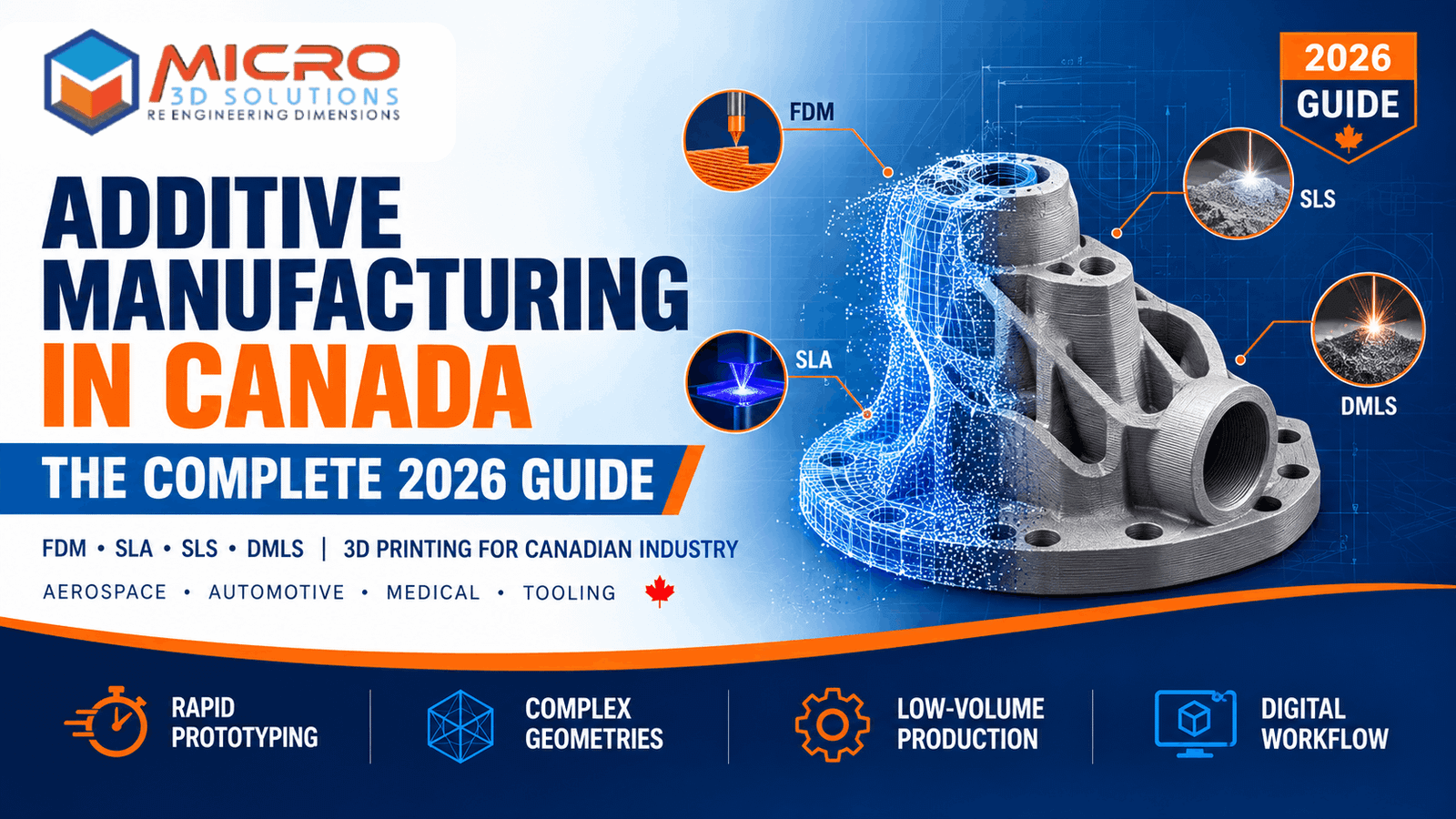
Additive manufacturing builds parts layer by layer directly from a digital 3D file, using technologies like FDM, SLA, and SLS — instead of removing material from a solid block, the way traditional machining works.
Get a Free Quote →What's Inside This Guide
By the engineering team at Micro 3D Solutions, GTA, Ontario — specialists in additive manufacturing, rapid prototyping, and 3D printing for Canadian industry.
📋 Table of Contents
- Additive Manufacturing in Canada: Key Numbers
- What Is Additive Manufacturing?
- Why Canadian Manufacturers Are Adopting AM
- Additive Manufacturing Technologies We Use
- Materials Used in Additive Manufacturing
- Industries We Serve in Canada
- Sustainability & Additive Manufacturing
- Additive vs. Traditional Manufacturing
- Quality Standards in Additive Manufacturing
- Our Additive Manufacturing Workflow
- When to Choose Additive Manufacturing
- Common Mistakes to Avoid
- Cost & Turnaround
- Frequently Asked Questions
From aerospace brackets to automotive tooling to medical models, additive manufacturing has moved well beyond prototyping into genuine production use across Canadian industry, backed by a growing domestic market and active federal research support.
This guide covers what additive manufacturing actually involves, which technologies and materials matter, how it compares to traditional manufacturing, and when it's the right choice for a project.
Additive Manufacturing in Canada: Key Numbers
| Metric | Figure | Source |
|---|---|---|
| Canada AM market size (2023) | USD 243.7 million | NextMSC |
| Canada AM market size (2030, projected) | USD 1.06 billion | NextMSC |
| Canada AM market CAGR (2024–2030) | 21.9% | NextMSC |
| Global AM revenues (2025) | USD 24.2 billion | Wohlers Report 2026 |
| Global AM services growth (2025, YoY) | 15.5% | Wohlers Report 2026 |
| North America share of global AM market | 33.8% | Grand View Research |
These figures point to a Canadian additive manufacturing sector growing well ahead of the broader manufacturing economy, with federal research support through the National Research Council of Canada adding further momentum behind domestic adoption.
What Is Additive Manufacturing?
What is additive manufacturing?
Additive manufacturing (AM), commonly known as 3D printing, builds a physical part by adding material layer by layer from a digital 3D model, rather than cutting or machining material away from a solid block.
The term "additive" describes exactly how the process works: a 3D printer deposits, cures, or fuses material one thin layer at a time, following the geometry of a digital CAD file, until the finished part is complete. This is the opposite of traditional subtractive manufacturing, where a machinist starts with a solid block of material and removes everything that isn't part of the final shape.
That layer-by-layer manufacturing approach unlocks geometries that traditional tooling simply can't produce — internal channels, organic curves, lattice structures — without needing multiple machining setups or custom tooling. It also means a design change doesn't require a new mold or fixture, just an updated digital file, which is why additive manufacturing has become central to both rapid prototyping and increasingly to low-volume production work.
A Brief History of Additive Manufacturing
Additive manufacturing traces back to the 1980s, when stereolithography was first patented as a way to rapidly produce concept models directly from CAD data. For roughly two decades, the technology stayed largely confined to prototyping, earning the popular nickname "rapid prototyping" that still describes one of its core uses today.
The shift toward genuine production use — printing end-use parts rather than just prototypes — has accelerated significantly over the past decade, as material properties, printer precision, and part consistency all improved enough to meet functional and, in some cases, regulated engineering requirements.
Design for Additive Manufacturing (DFAM)
Designing a part specifically for 3D printing, rather than adapting a design originally intended for machining or molding, is often what separates a successful additive manufacturing project from a disappointing one.
Design for Additive Manufacturing (DFAM) principles account for how each process actually builds a part — orientation on the print bed, support structure requirements, wall thickness limits, and how layer direction affects mechanical strength. A part redesigned with DFAM in mind can often be lighter, stronger, and cheaper to print than a direct copy of a traditionally manufactured equivalent.
Why Canadian Manufacturers Are Adopting Additive Manufacturing
Canada's additive manufacturing market was valued at approximately USD 243.7 million in 2023 and is projected to reach roughly USD 1.06 billion by 2030, a compound annual growth rate of about 21.9% according to NextMSC's analysis — growth driven by manufacturers moving AM from a prototyping tool into genuine production use.
The National Research Council of Canada maintains an active additive manufacturing research program, supporting Canadian industry in adopting AM for both polymer and metal applications. That kind of institutional backing signals a maturing technology rather than an experimental one, and it's part of why manufacturers across aerospace, automotive, and defence supply chains are investing in AM capability now rather than waiting.
For global context, the Wohlers Report 2026 put worldwide AM revenues at USD 24.2 billion in 2025, with AM services specifically growing 15.5% year over year — outpacing system sales at 3.6% and pointing to an industry where value is shifting toward production and service delivery rather than new hardware.
North America accounts for roughly a third of that global market according to Grand View Research, and Canada's growth trajectory broadly tracks this larger North American pattern, with local manufacturers benefiting from proximity to both established aerospace and automotive supply chains and the research infrastructure the NRC provides.
Additive Manufacturing Technologies We Use
Not all 3D printing technologies serve the same purpose. Choosing the right one depends on the material, the required accuracy, and whether the part is a concept model, a functional prototype, or a production part.
FDM (Fused Deposition Modeling)
FDM builds parts by extruding melted thermoplastic filament layer by layer through a heated nozzle, with the print head tracing each layer's cross-section before the build plate steps down for the next. It's the most widely used and most affordable additive manufacturing process, well suited to functional prototypes, jigs, fixtures, and low-volume production parts in engineering-grade thermoplastics. Layer lines are typically visible, and mechanical strength varies by print orientation, but for functional testing and low-cost tooling, FDM remains the workhorse.
SLA (Stereolithography)
SLA uses a laser to cure liquid photopolymer resin layer by layer, producing parts with a smooth surface finish and fine detail well beyond what FDM can achieve. It's the preferred choice for concept models, detailed prototypes, and applications like jewelry patterns or dental models where surface quality and dimensional precision matter more than raw mechanical strength. The trade-off is material cost and, in many resins, more brittle mechanical properties.
SLS (Selective Laser Sintering)
SLS uses a laser to fuse polymer powder particles together, layer by layer, with unfused powder in the build chamber acting as natural support for overhangs and complex geometry — eliminating the need for support structures FDM and SLA often require. This makes SLS well suited to complex geometries and functional, engineering-grade prototypes that need to withstand real mechanical stress, including snap fits, living hinges, and interlocking assemblies printed fully formed.
DMLS (Direct Metal Laser Sintering)
DMLS extends the same laser-sintering principle to metal powders, producing fully dense metal parts directly from a digital file, layer by layer, inside a controlled, inert-gas build chamber. It's used for metal 3D printing applications in aerospace, automotive, and tooling where a functional metal part — not just a prototype — is the end goal, often requiring post-print heat treatment and machining to reach final specification.
| Technology | Best For | Surface Finish | Typical Materials |
|---|---|---|---|
| FDM | Functional prototypes, jigs, fixtures, low-volume parts | Moderate — visible layer lines | ABS, PLA, Nylon, PETG |
| SLA | Concept models, detailed prototypes, patterns | Excellent — smooth, fine detail | Photopolymer resins |
| SLS | Complex geometries, functional engineering parts | Good — slightly grainy, no supports needed | Nylon (PA11, PA12) |
| DMLS | Functional metal parts, aerospace & tooling components | Good — often machined post-print | Titanium, Aluminum, Stainless Steel |
Many projects use more than one technology across a single product's development — SLA for the initial concept model, FDM for functional prototype testing, and SLS or DMLS for the final engineering-grade or production part.
Materials Used in Additive Manufacturing
Material choice depends on whether the part needs to look right, fit correctly, or actually perform under load — and different additive manufacturing processes support different material families, each with its own trade-offs between cost, strength, and finish quality.
Polymers
Polymer 3D printing covers the widest range of applications, from basic PLA concept models to engineering-grade nylon and ABS parts that need to withstand real mechanical stress, heat, or chemical exposure in a working assembly. Within this category, material choice varies significantly: PLA suits low-stress visual models, ABS and PETG hold up better under mechanical load and moderate heat, and reinforced nylons approach the toughness needed for genuine functional and end-use parts.
Metals
Metal 3D printing through DMLS and similar processes uses powders like titanium, aluminum, and stainless steel to produce fully functional metal parts, common in aerospace brackets, tooling inserts, and components where weight reduction matters without sacrificing strength. Titanium in particular has become a standard aerospace AM material thanks to its strength-to-weight ratio, despite being one of the more expensive and slower materials to print.
Composites & Specialty Materials
Fiber-reinforced filaments, flexible elastomers, and high-temperature engineering polymers round out the material options, letting a single additive manufacturing process serve applications ranging from soft-touch prototypes to under-hood automotive components. Carbon-fiber-reinforced filaments, for example, add stiffness and dimensional stability to FDM parts that would otherwise be too flexible for structural use.
Industries We Serve in Canada
Aerospace
Lightweight brackets, ducting, and tooling components benefit from AM's ability to produce complex, weight-optimized geometries — including internal lattice structures — that traditional machining can't achieve as efficiently.
Automotive
Jigs, fixtures, and functional prototypes speed up development cycles, while low-volume production parts support specialty and aftermarket applications without injection mold tooling costs.
Medical & Device Prototyping
Engineering-grade prototypes and device housings benefit from rapid iteration speed, letting design teams test multiple versions in the time it would take to machine a single traditional prototype.
Oil & Gas
Custom tooling, jigs, and replacement components for legacy equipment can be produced on demand, reducing downtime when original parts are no longer manufactured.
Tool & Die
Conformal-cooled tooling inserts and fixture components can outperform conventionally machined tooling, since AM can place cooling channels along the exact contour of a mold cavity. This often pairs with reverse engineering of legacy tooling with no surviving drawings.
Sustainability & Additive Manufacturing
Additive manufacturing's layer-by-layer approach inherently uses less raw material than subtractive processes, since material is deposited only where the final part needs it rather than machined away from a larger block. For industries producing complex or lightweight components, that difference in material efficiency can be substantial over the life of a production program.
On-demand production is another sustainability angle worth noting: because parts print directly from a digital file with no tooling required, manufacturers can produce spare parts and low-volume components closer to when and where they're actually needed, rather than maintaining large inventories of parts that may never be used. For legacy equipment in sectors like oil & gas, this on-demand model also extends the usable life of machinery that would otherwise be retired once original replacement parts become unavailable.
Additive vs. Traditional Manufacturing
| Factor | Additive Manufacturing | Traditional Manufacturing |
|---|---|---|
| Tooling required | None — parts print directly from a digital file | Molds, dies, or fixtures often required |
| Design complexity | Complex geometries produced at no extra cost | Complex shapes increase cost and setup time |
| Material waste | Minimal — material added only where needed | Higher — excess material is machined away |
| Speed for low volumes | Fast — no tooling lead time | Slower — tooling must be built first |
| Cost at high volumes | Higher per-part cost at scale | Lower per-part cost once tooling is amortized |
The practical rule of thumb: additive manufacturing wins on low-volume, complex, or rapidly iterating parts, while traditional manufacturing still wins once a design is finalized and production volume is high enough to amortize tooling costs.
Quality Standards in Additive Manufacturing
As additive manufacturing has moved into production use, the industry has developed formal standards to define terminology, processes, and quality expectations — important context for any manufacturer evaluating a supplier's capability.
ISO/ASTM 52900
This is the foundational international standard defining additive manufacturing terminology, including the formal definitions for processes like material extrusion (FDM), vat photopolymerization (SLA), and powder bed fusion (SLS and DMLS). It gives manufacturers and suppliers a shared vocabulary when specifying a project's requirements, and is maintained jointly by ASTM International and ISO.
Industry-Specific Quality Requirements
Aerospace and defence applications often layer additional quality requirements on top of general AM standards, such as AS9100 quality management certification, material traceability documentation, and process validation specific to flight-critical or safety-critical components. Medical device prototyping, similarly, may need to align with design control practices even at the prototype stage, ahead of any formal regulatory submission.
Our Additive Manufacturing Workflow
A typical additive manufacturing project moves through six stages, from initial design file to a finished, inspected part.

Design Review
Your CAD file is reviewed for printability — wall thickness, overhangs, and tolerances are checked against the chosen additive manufacturing process before printing begins.
File Preparation & Slicing
The 3D model is oriented, supported if needed, and sliced into printable layers, with settings tuned to the part's required strength, finish, and material.
3D Printing
The part is printed using the technology best suited to the project — FDM, SLA, SLS, or DMLS — depending on material, accuracy, and functional requirements.
Post-Processing
Support removal, sanding, curing, or machining is performed depending on the process and the finish the part needs.
Quality Inspection
Finished parts are checked against the original CAD file for dimensional accuracy through quality inspection, using 3D scanning for critical or complex geometries where visual inspection isn't sufficient.
Delivery
The finished part is packaged and delivered, along with any documentation the project requires.
When to Choose Additive Manufacturing
- Rapid prototyping — testing form, fit, and function before committing to production tooling
- Low-volume production — when order quantities don't justify mold or die costs
- Complex geometries — internal channels, lattices, or organic shapes traditional tooling can't produce
- Custom or replacement parts — one-off components for legacy equipment with no existing tooling
- Functional testing — engineering-grade prototypes that need to perform under real load before final design sign-off
For high-volume production of a finalized design, traditional manufacturing methods like injection molding generally still offer a lower per-part cost — additive manufacturing's advantage is speed, flexibility, and design freedom, not high-volume unit economics.
Ready to Start Your Additive Manufacturing Project?
Whether it's a single functional prototype or a low-volume production run, our team can recommend the right technology and material for your part.
Request a Free Quote →Common Mistakes to Avoid
Designing Without Considering Process Limits
A geometry that works well in SLS might need extensive support structures in FDM, adding cost and post-processing time that could have been avoided with an earlier design review.
Choosing Material on Cost Alone
A prototype validated in one material won't necessarily perform the same way in production if the final part switches materials without re-testing against actual working conditions.
Skipping Quality Inspection on Functional Parts
Skipping inspection on functional or safety-relevant parts leaves dimensional or structural issues undiscovered until the part fails in the field.
Cost & Turnaround for Additive Manufacturing Projects
Pricing for additive manufacturing projects depends primarily on part size, material, technology, and quantity, rather than following a flat rate. A small FDM prototype costs and processes far faster than a batch of DMLS metal parts requiring extensive post-processing.
Turnaround time varies by process and complexity — many prototype parts can be printed within a day or two, while metal or highly finished parts requiring post-processing take longer. Because pricing and lead time vary so much by project scope, quotes are typically provided after reviewing the specific part file, material, and quantity needed.
Summary: Key Takeaways
Additive manufacturing has moved from a prototyping novelty to a genuine production tool across Canadian aerospace, automotive, medical, and industrial sectors, supported by a fast-growing domestic market and active federal research backing. Choosing the right technology and material for a specific part — not defaulting to a single process for every job — is what separates a successful additive manufacturing project from a disappointing one.
Whether the goal is a same-week functional prototype or a low-volume production run of a complex part, matching the process to the project's actual requirements is the foundation everything else builds from.
Frequently Asked Questions
What is additive manufacturing used for?
Additive manufacturing is used for rapid prototyping, functional testing, low-volume production, custom tooling, and manufacturing complex geometries that are difficult or impossible to produce with traditional machining or molding. It spans everything from early concept models through functional prototypes tested under real working conditions, to fully certified production parts in aerospace, automotive, and medical device applications.
What's the difference between FDM, SLA, and SLS?
FDM extrudes melted thermoplastic filament and is the most affordable and widely used method, well suited to functional prototypes and low-volume parts. SLA cures liquid resin with a laser for high detail and smooth surface finish, ideal for concept models. SLS fuses polymer powder without needing support structures, making it well suited to complex, functional parts with interlocking features. Each trades off speed, cost, finish, and strength differently.
Is additive manufacturing cheaper than traditional manufacturing?
It depends on volume. Additive manufacturing avoids tooling costs entirely, making it more affordable for prototypes and low-volume runs. At high production volumes, traditional methods like injection molding typically offer a lower cost per part once tooling is amortized across thousands of units. The crossover point varies by part complexity and size.
Can additive manufacturing produce metal parts?
Yes. Processes like DMLS (Direct Metal Laser Sintering) fuse metal powders such as titanium, aluminum, or stainless steel into fully functional metal parts, commonly used in aerospace and tooling applications.
How accurate are 3D printed parts?
Accuracy depends on the technology, machine calibration, and material used. SLA generally offers the finest detail and tightest tolerances, while FDM accuracy varies more with printer quality and settings. Quality inspection against the original CAD file confirms dimensional accuracy for critical parts.
How long does an additive manufacturing project take?
Turnaround depends on part size, complexity, material, and post-processing needs. Simple prototypes can often be printed within a day or two, while larger or metal parts requiring extensive post-processing take longer. Quotes typically include a project-specific timeline.
How much do additive manufacturing services cost?
Cost depends on part size, material, technology, and quantity. A small polymer prototype costs significantly less than a batch of finished metal parts. Contact us with your part file and quantity for a specific quote.
Final Thoughts
Additive manufacturing gives Canadian manufacturers something traditional processes can't: the ability to produce complex, functional parts without tooling, lead time, or the design compromises machining imposes. That advantage is strongest in prototyping and low-volume work, and it's exactly where most Canadian AM adoption is concentrated right now.
Matching the process, material, and design approach to what a part actually needs is what makes the difference. Talk to the Micro 3D Solutions team with your part file for a project-specific recommendation.
📚 References & Industry Sources
- National Research Council of Canada (NRC) — active additive manufacturing research program supporting Canadian industry. nrc.canada.ca
- ASTM International / ISO — ISO/ASTM 52900, the international standard defining additive manufacturing terminology and processes. astm.org
- Wohlers Associates — publishers of the annual Wohlers Report on the additive manufacturing industry. wohlersassociates.com
- Next Move Strategy Consulting (NextMSC) — Canada additive manufacturing market analysis. nextmsc.com
- Grand View Research — global additive manufacturing market and regional share analysis. grandviewresearch.com